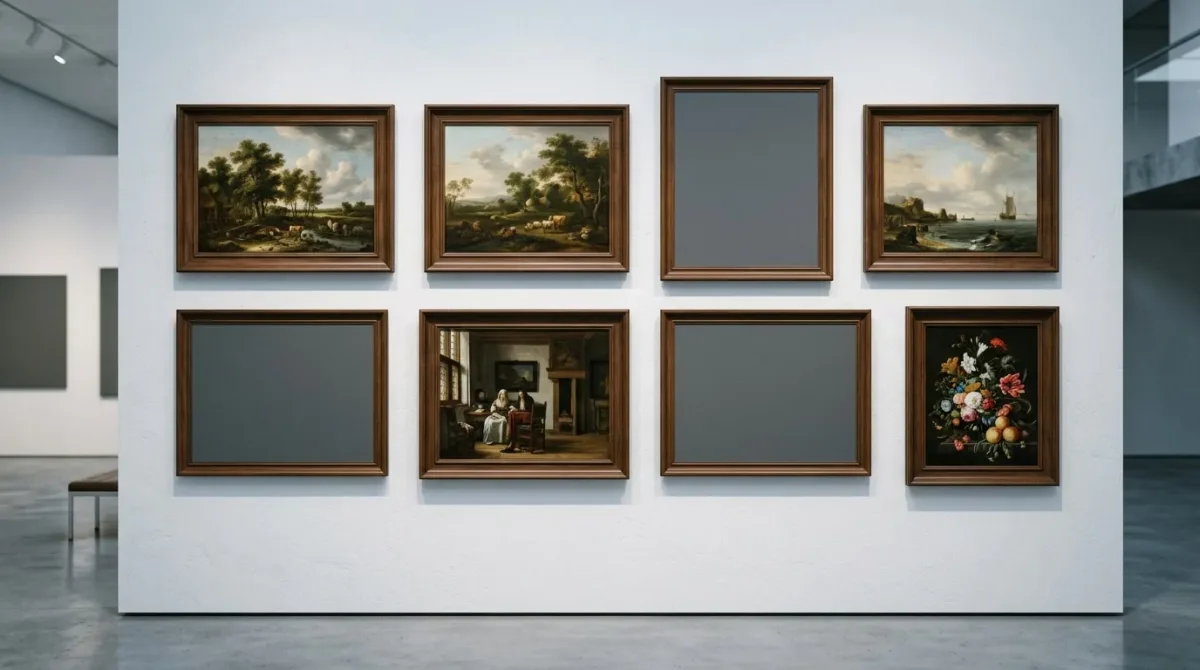
Open access is a museum licensing program that releases images of public-domain works for unrestricted reuse, and it explains a quiet rule of art criticism: reviews illustrate old art easily and new art rarely. The Metropolitan Museum of Art offers more than 492,000 such images under Creative Commons Zero. Works still under copyright are excluded.
That single exclusion shapes more of what readers see next to a review than any editorial judgment does. A critic can write about anything. A picture desk can only publish what it can clear.
What does “open access” actually mean at an American museum?
It means the institution has waived its own claims over reproductions of works already in the public domain, usually through a Creative Commons Zero dedication. The Met describes making images of public-domain artworks and basic data on all accessioned works in its collection available for unrestricted use under CC0. No fee, no form, no permission.
The scale is not trivial. The Smithsonian Institution puts more than 5.1 million two- and three-dimensional digital items across its museums, research centers, libraries and archives into its open access program under CC0, inviting users to download, share and reuse them, in its phrasing, without asking.
The National Gallery of Art runs a narrower but equally unencumbered program: more than 60,000 images from its public-domain collection, which the Gallery states are available free of charge for any use, whether commercial or non-commercial, with no permission, fee or attribution required. Attribution is encouraged, not demanded.
Three programs, three very different inventories, one common boundary. All of them stop at copyright.
Why can’t a review of a contemporary show use those images?
Because open access datasets are keyed to public-domain status, not to collection membership. The Met’s CC0 release covers public-domain artworks specifically; anything still under copyright sits outside the dataset and is routed through an image request instead. A 1650 altarpiece is free. A 2019 painting by a living artist is a negotiation.
The Smithsonian is explicit on the same point. Its open access FAQ excludes items under copyright, and flags a second tier of assets marked “usage conditions apply,” which are restricted from commercial use even when they are viewable. Two different gates, both invisible to a reader looking at a review.
The practical consequence is a structural tilt in illustrated criticism. Coverage of Old Masters, nineteenth-century painting, historical photography and antiquities is cheap to publish. Coverage of anything made in roughly the last century carries a clearance cost, a delay, or a refusal, and the artist’s estate or gallery often holds the deciding vote.
What rights does a museum actually control?
Less than most readers assume. The National Gallery of Art attaches a caveat to its open access terms stating that the Gallery can only convey what rights it has, and makes no representations or warranties that persons or entities other than the Gallery will not impose fees for use. Owning the object is not owning every right in the image of it.
The Smithsonian says the same thing more bluntly. Its FAQ warns that a user is responsible for obtaining any third-party permissions that may be required, noting that a third party may claim rights in the content such as trademark, privacy, or publicity rights. Institutional branding is carved out separately: the Smithsonian logo and other trademarks are excluded from the open access program and cannot be used without prior written permission.
So a CC0 designation clears one party. It does not clear an artist’s estate, a photographer, a lender, a sitter, or a trademark holder. Editors treat open access as the beginning of a clearance chain, not the end of one.
Does fair use cover an image in a review?
Possibly, and never automatically. The U.S. Copyright Office states in its public guidance that it is permissible to use limited portions of a work including quotes, for purposes such as commentary, criticism, news reporting, and scholarly reports — the exact categories criticism lives in. It then declines to draw a line.
Whether a particular use qualifies as fair use, the Office says, depends on all the circumstances, and only a federal court can determine whether a particular use is, in fact, a fair use under the law. Its own recommendation in ambiguous situations is to obtain permission.
That guidance is not legal advice and does not resolve any specific case; publications set their own risk thresholds with counsel. What it does explain is why two outlets reviewing the same exhibition can run visibly different picture packages. One newsroom’s tolerance is another’s hard no.
How do the three programs compare?
| Program | Stated scale | License / terms | Stated boundary |
|---|---|---|---|
| The Metropolitan Museum of Art | More than 492,000 images | Creative Commons Zero, unrestricted use | Public-domain artworks only; other works via image request |
| Smithsonian Institution | More than 5.1 million 2D and 3D items | Creative Commons Zero | Items under copyright excluded; “usage conditions apply” assets restricted from commercial use; logo and trademarks excluded |
| National Gallery of Art | More than 60,000 images | Free for any use, commercial or non-commercial; no permission, fee or attribution required | Public-domain collection; Gallery conveys only the rights it holds |
Read the third column first. The scale numbers are the marketing; the boundaries are the operating reality.
How does an editor clear a picture for a review?
The sequence below follows what the three institutions state in their own published terms, and it is the order most picture desks work in when a review is due.
- Establish the work’s copyright status, not its owner. The Met’s CC0 release is defined by public-domain status; collection membership alone decides nothing.
- Check the object record for a second tier. The Smithsonian marks some viewable assets “usage conditions apply,” restricting commercial use even outside a copyright claim.
- Assume third-party rights survive the license. The Smithsonian places responsibility for trademark, privacy and publicity permissions on the user, and the National Gallery warns that others may still impose fees.
- Route in-copyright works to the press office or rights holder. The Met directs works outside open access to an image request; that is where an artist’s estate or gallery enters the process.
- Decide the fair-use question with counsel, not by instinct. The Copyright Office lists criticism among favored purposes but says the outcome depends on all the circumstances and only a court can settle it.
What does this mean for how criticism reads?
It means the visual record of art criticism runs decades behind the writing. The National Gallery’s 60,000-plus open images and the Smithsonian’s millions are, by construction, an archive of the out-of-copyright past, while the shows that move markets and careers are overwhelmingly in-copyright.
Collectors and institutions feel this second-hand. A contemporary artist’s market narrative is built partly on circulated images, and circulation is gated by whoever controls reproduction rights — frequently the gallery or estate with a commercial interest in how the work is framed. Historical material carries no such gatekeeper.
None of this is a scandal, and none of it is fixed. Open access programs have kept expanding, and every image that ages into the public domain widens what criticism can show for free. The lag is the point. Reviews of the deep past will always be easier to illustrate than reviews of the present.
For a related art news perspective, read How Buyer's Premiums Work in Art Auctions, and Why Sotheby's Just Raised Its Rates.