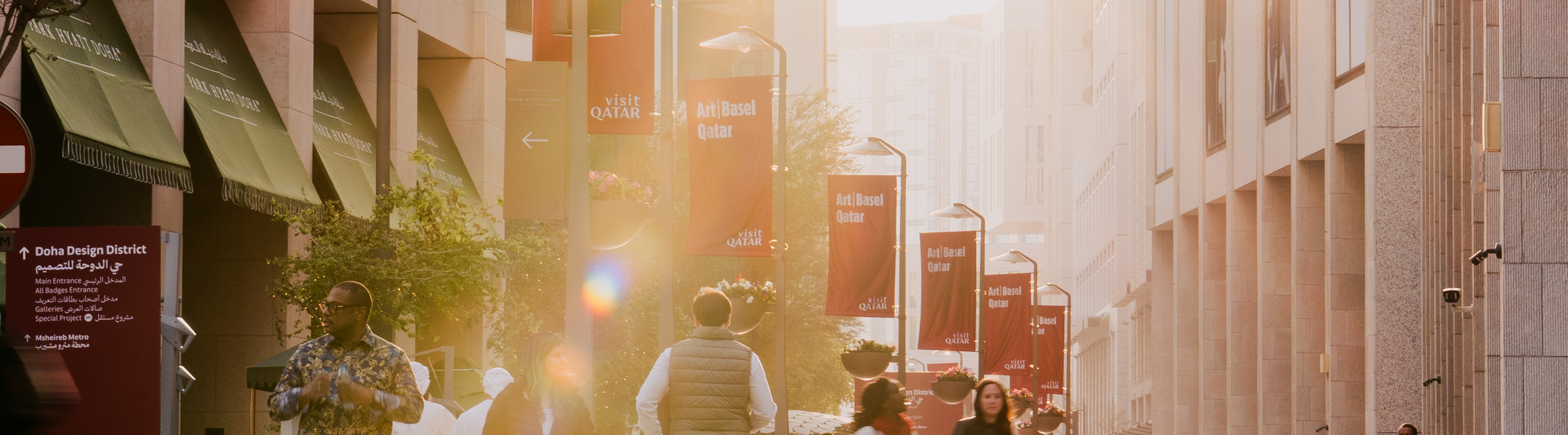
Art Basel Qatar's second edition will lean harder on its host city than its debut did: the fair, running January 28–30, 2027 (with previews January 26–27) across Msheireb Downtown Doha, has unveiled a reimagined public program anchored by two monumental site-responsive commissions, according to the announcement from Art Basel. The Galleries sector unites 81 galleries from 37 countries and territories, with works by 80 international artists—half from the MENASA region.
Why it matters: the expansion signals that Art Basel's newest fair is being built as infrastructure rather than an annual event. Alongside the public program, the fair is launching a Collectors Majlis in October 2026 that runs beyond this fair cycle, offering locally based collectors masterclasses, workshops, collection visits, salons, and invitation-led encounters. For galleries weighing the cost of a Doha booth, the message is that the fair intends to cultivate a regional collector base between editions, not simply import one each January.
"With its second edition, Art Basel Qatar develops an approach that looks beyond the fair itself, paying close attention to the relationships and conversations that can be cultivated around it," said Vincenzo de Bellis, Chief Artistic Officer and Global Director of Art Basel Fairs, in the announcement. The fair is presented in partnership with Qatar Sports Investments (QSI) and QC+, with Visit Qatar as Lead Partner and Qatar Airways, UBS, BMW, and Audemars Piguet among the partner roster.
What are the two Special Projects?
The Special Projects program, curated by Artistic Director Wassan Al-Khudhairi in collaboration with de Bellis, installs two immersive environments designed to connect the fair's two main locations. In Barahat Msheireb Square, New York-based Büro Koray Duman will build a sloping, carpeted structure from locally sourced palm waste and Hasir—a carpet woven from palm leaves—with stepped seating around a shared center. The structure will host the entire Art Basel Conversations program in the square, open to all, and after the fair it will move to a permanent home at Heenat Salma, the Caravane Earth Foundation eco-farm supplying the materials and craftsmanship. Al-Khudhairi noted the design draws on temporary bamboo structures across South Asia and Qatari artisan traditions.
In the Doha Design District Atrium, the pioneering publishing collective Bidoun collaborates with artist Farah Al Qasimi on an immersive environment built around her photographic language. The project bundles a pop-up café, a micro-library of Gulf avant-garde publishing, a screening area, and a copy shop organized by artist and Bidoun contributing editor Sophia Al-Maria where visitors can obtain facsimiles of rare texts and zines. Artist and writer Abdullah Al Mutairi is commissioned to chart an idiosyncratic history of the Gulf through its art exhibitions.
Who is showing in the Galleries sector?
The booth list pairs regional heavyweights with blue-chip Western galleries, a mix that frames the fair's between | بين theme—curatorial language about being "between" as a generative condition of encounter and exchange. The Third Line (Dubai) presents new large-scale paintings by Vian Sora; Vigo Gallery (London) brings two major Ibrahim El-Salahi works from his Haraz series; Sfeir-Semler shows 1960s and '70s works by Aref El Rayess, including the complete 22-panel installation Temps Moderne et Tiers Monde (1974–75); and ATHR (Jeddah) presents an immersive installation by 2025 Art Basel Gold Awardee Mohammad Alfaraj.
The Western contingent leans into the region, too. Gagosian shows new Maurizio Cattelan works pairing gold-plated steel panels from MOUTH (2025), each pierced by gunshots, with Notre Dame (2025), a raw Carrara-marble sculpture. Paula Cooper Gallery brings Frank Stella's BAFQ (1965), a shaped canvas inspired by his 1963 journey to Iran, alongside studies from his Moroccan Paintings series. David Zwirner shows new Oscar Murillo paintings, White Cube presents late Park Seo-Bo works, and Silverlens shows Pacita Abad's trapunto paintings of Yemeni doors.
The original angle worth watching: Doha's institutional calendar is stacking up around the fair. The week anchors Design Doha 2026 (through January 31), the launch of Rubaiya Qatar—a new contemporary art quadrennial with more than 120 artists—plus a permanent Gerhard Richter-designed Doha Pavilion opening in MIA Park on November 20, a Giuseppe Penone survey at the National Museum of Qatar, and a Mathaf exhibition on the Baghdad Modern Art Group. No fair launches into that much institutional programming by accident; the question is whether the collector base grows fast enough to sustain all of it.
Image: Courtesy Art Basel.