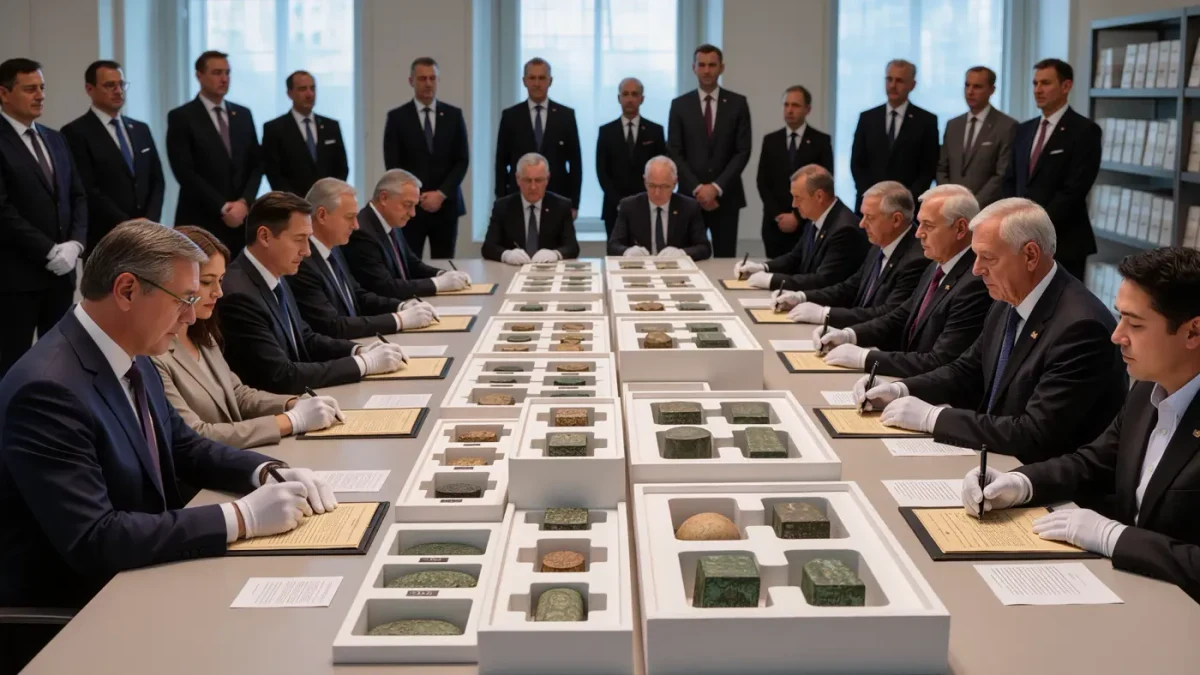
The Manhattan District Attorney's Office announced the return of 657 looted antiquities worth nearly $14 million to India in May 2026, according to The Art Newspaper, May 20, 2026 — the largest single repatriation of the year and one of the biggest in the unit's history. The handover followed investigations into international trafficking networks, and it confirms a pattern that has quietly become the defining enforcement story of the decade: an American prosecutor's office, not a museum regulator, now effectively polices the antiquities trade.
How Big This Run Has Been
The India return was not an outlier. Manhattan DA Alvin Bragg's office previously repatriated 29 looted antiquities to Greece in October 2025 — a handover the American School of Classical Studies at Athens documented — along with 43 antiquities valued at more than $2.5 million to Türkiye, and 31 objects to Spain, Italy and Hungary in a multi-country ceremony. Earlier Italian returns ran into the hundreds of objects. The through-line is a database-and-subpoena strategy: seizures from dealers, galleries and museum storage, followed by provenance reconstruction and repatriation at press-conference scale.
Why Museums Keep Surrendering Objects Voluntarily
- Once the ATU opens an investigation, litigation is rarely winnable — seizure warrants against trafficked property do not turn on limitations technicalities the way civil restitution suits do.
- Voluntary surrender lets institutions frame the outcome as due diligence rather than defeat, preserving relationships with source countries that control excavation cooperation and loans.
For acquisition policy, the effect is already visible: American museums have tightened ancient-art intake to a trickle, and anything with a Subhash Kapoor-adjacent or 1970-pre-and-post provenance gap is effectively unbuyable at institutional level. The private market has not caught up, which makes pre-1970 antiquities the least liquid category in the collector portfolio — cheaper, on paper, and harder to exit every year.
The Question the Press Releases Skip
Repatriation counts measure enforcement output, not market contraction. The 657 objects returned to India were looted decades before they were seized; the trafficking networks monetized them long ago. What the numbers cannot yet show is whether source-country site looting has actually slowed. The unit's own theory — that drying out the demand side starves the supply side — is plausible, but the measurable beneficiaries so far are the source countries' cultural ministries and the DA's press operation. That is not nothing. It is also not the same as a clean market.
For collectors holding ancient material, the practical guidance is blunt: assume any object without a documented pre-1970 export history is unsellable to a U.S. institution, uninsurable at purchase price by the cautious carriers, and seizable. The 2026 numbers make the reputational math simple — 657 objects, one press release, and every registrar in America re-reading their accession files.