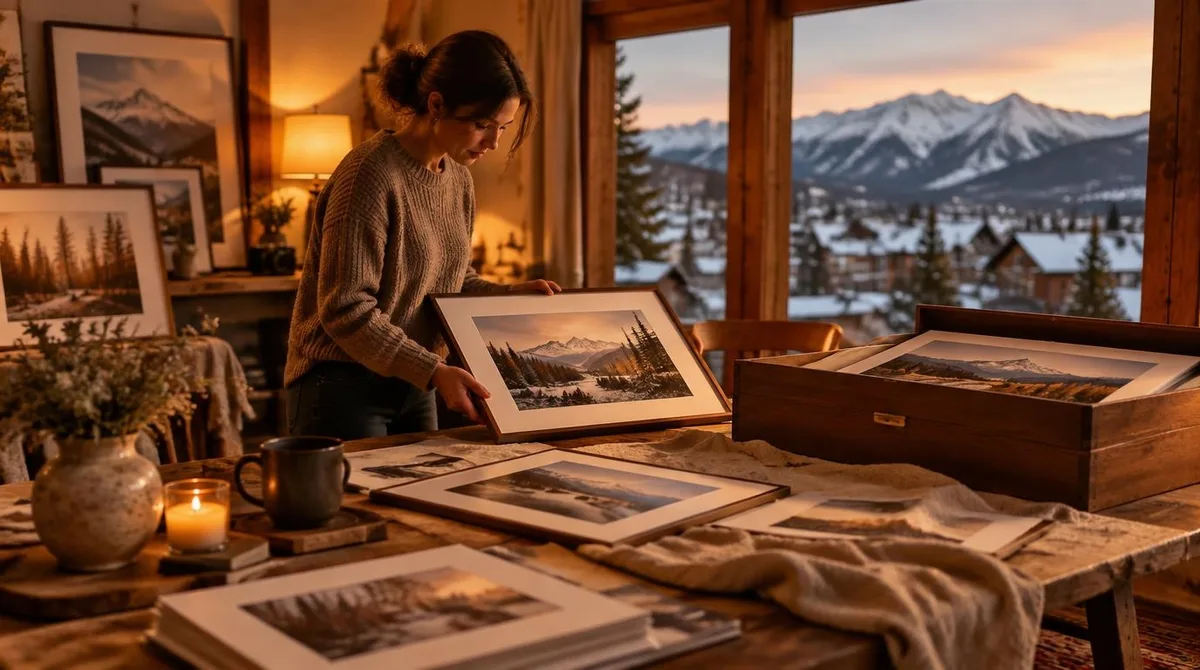
The Arts Council of Park City & Summit County marks 40 years of supporting arts, culture and local artists with a birthday party on Wednesday, and one longtime beneficiary sums up both the achievement and the open question. Photographer Mark Maziarz credits the council with helping him shift from commercial photography to fine art photography over the past 11 years. Yet the organization, after four decades, still lacks what he calls its top goal: a permanent home.
That tension is the honest way to read the anniversary. The Park Record reports the council has built programs that gave Maziarz a place to sell work, a place to experiment, and business training through its ArtWORKS workshops. But Maziarz's own account of the council's real estate history — a beloved Main Street storefront lost, cheaper spaces that fell short, a comparison to a small Arizona town with an artist colony in an old high school — suggests the regional arts infrastructure here remains provisional. Support, in this case, has meant people and programs more than buildings.
For readers tracking how artists actually sustain careers outside the big coastal markets, the Park City case is worth weighing carefully. It is a story about a modest, volunteer-stretched organization doing real work — and about the limits of what such work can accomplish without secured space. Councils like this one sit in a wider ecosystem of artists' support structures, from member-run associations to residency programs, each with its own trade-offs.
What has the Arts Council actually delivered for artists?
By Maziarz's account, the concrete benefits are threefold. First, a place to sell: the council ran BRAND PC, a program supporting creative entrepreneurs that included a storefront holiday market where Maziarz first exhibited, in a basement space near Bonanza Park. BRAND PC later folded into CREATE PC, which provides a studio and sales space for local artists at 1500 Kearns Blvd, Suite F-110.
Second, room to experiment. "Corollary to that, and almost as important, is that they give me a place to experiment with my work," Maziarz told the Park Record. "There are a number of things I've made just to test the market. CREATE PC, specifically, is a great place to display those experiments. Sometimes they work. Sometimes they don't." That kind of low-stakes testing ground is rare, and it matters for artists moving between markets — a transition he describes as involving "different sets of issues" than commercial work.
Third, business training. The council's ArtWORKS workshops, according to Maziarz, provide "local artists and creative entrepreneurs training and tips to turn hobbies into sustainable careers." "They're like the business of art, and they are really good," he said. For artists weighing how to build income streams beyond the studio door, that practical curriculum is often the difference between a hobby and a livelihood — a theme explored in How Artists Make Money — How Artists Actually Make a Living. For related coverage, see How Artists Make Money — How Artists Actually Make a Living: The Income Streams Behind the Studio Door.
How much weight should one artist's testimony carry?
A measured reading requires some skepticism here. The evidence for the council's effectiveness comes almost entirely from Maziarz, a volunteer and self-described admirer — "Everyone is so honest," he said, adding, "I don't feel like there is some ulterior motive in what they are doing." He is a credible witness to his own experience, and the article attributes the program details to him as well. But this is a profile of a satisfied beneficiary, not an audit. No attendance figures, sales totals, or artist counts appear in the reporting, so the council's reach across Summit County cannot be independently sized from this source.
What the testimony does establish, sharply, is the mechanism: visibility and community. Maziarz describes CREATE PC's rotating exhibitions and opening parties as a place "to talk with collectors about art" and to meet fellow artists. "We talk about what we're all working on and what kinds of other ideas we all have," he said. For artists selling without gallery representation, that direct collector access is precisely the kind of alternative channel that determines whether a regional practice survives — a dynamic covered in Selling Without a Gallery: The Instagram Market, the Platforms, and the Ceiling.
Why does the missing permanent space matter so much?
Because location, in Maziarz's telling, drove results. The BRAND PC storefront at 660 Main Street — now the site of Le Depot Brasserie — drew heavy walking traffic. "It was a wonderful space because it drew a lot of Main Street walking traffic and space for a lot of artists," he said. Later Main Street locations, by his account, "weren't a fraction of what the Depot was like in terms of visibility." The lesson he draws: "That brought to light their struggle to find a space that is affordable."
Maziarz offers a pointed comparison from earlier this year, when he visited Jerome, Arizona, a former mining town of, in his estimate, fewer than 1,000 people. "They had an old high school they stopped using 20 or 30 years ago and turned it into an artist colony," he said. "We don't have that, but I think we could have if everybody had some foresight. We could have found a cheap parcel of land to build something years ago, but now everything is so expensive." The observation doubles as a critique of timing: the window for cheap land, in his view, has closed. What Jerome managed — converting dormant civic space into an artist colony — is the kind of calculus behind What Artist Residencies Are Actually Worth: Studios, Stipends, and the Career Math. We covered a connected angle in What Artist Residencies Are Actually Worth: Studios, Stipends, and the Career Math.
The counterweight is Maziarz's own reading of the council's priorities. "From my perspective as an artist, I feel like their No. 1 goal is to get a cool permanent space to help local artists," he said. "I think everything they are doing is to support that." Whether four decades of programming can be converted into secured real estate, in a town where the evidence says everything is now expensive, is the question the anniversary does not answer.
What happens next?
The 40th Birthday Bash runs 4–8 p.m. Wednesday at CREATE PC, 1500 Kearns Blvd, Suite F-110. Admission is free, with RSVPs encouraged through the council's listing, and details at pcscarts.org. Maziarz, for one, is looking ahead: "There's a lot of cool art happening in town, and it keeps popping up. I can't wait to go to their '80s prom party to celebrate 40 years, and here's to 40 more." The party is easy to report. The permanent home remains the story to watch.