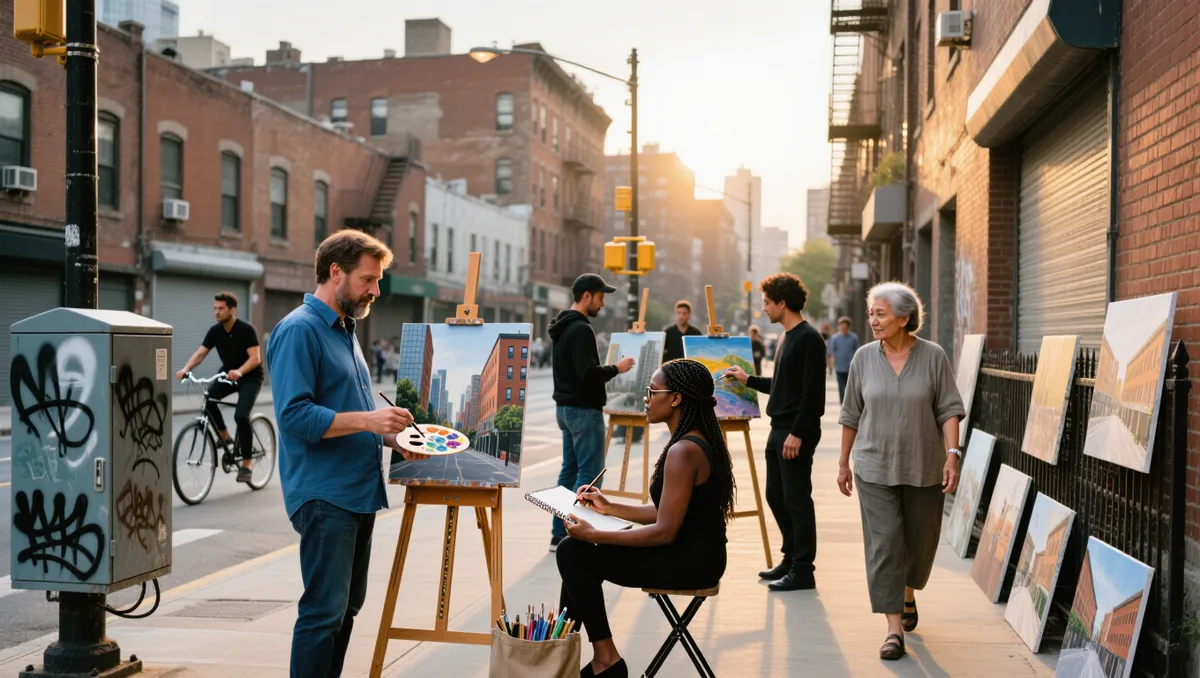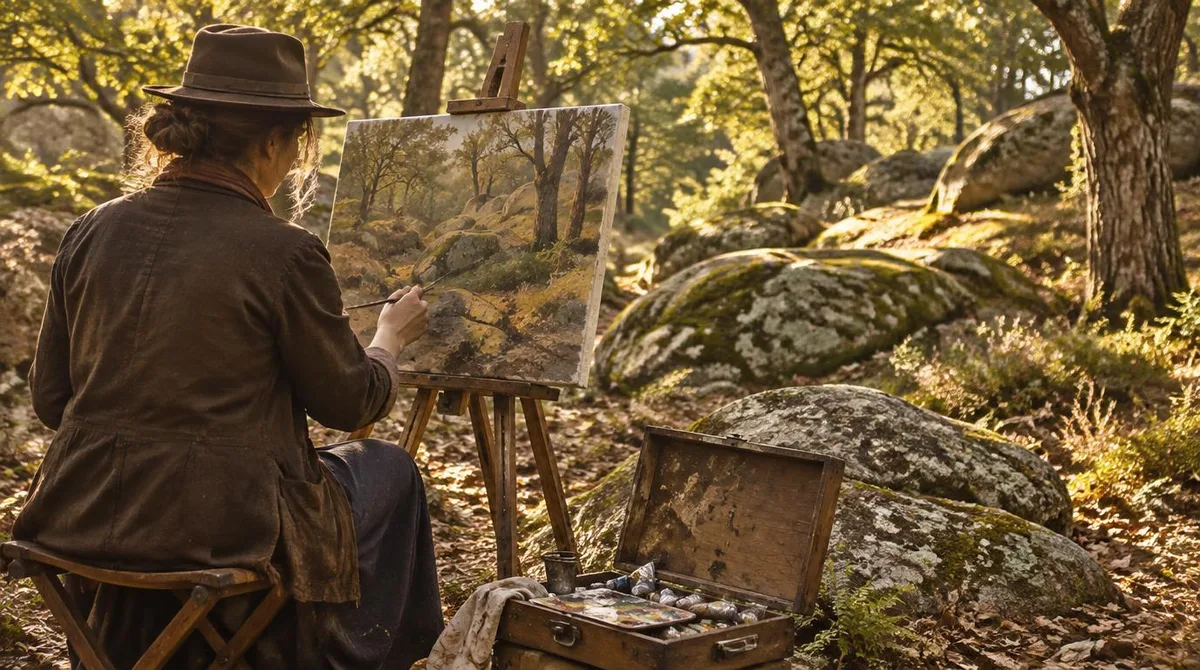
Plein air painting is the act of painting outdoors, in front of the subject, with the canvas set up on site. The phrase is French for "outdoors." A painter working this way paints directly inside the landscape, racing the weather and the light. Monet built a career on the method, and so did whole schools of painters from Fontainebleau to Sydney.
The draw is light itself. Studio work runs on memory and sketches. Outdoor work runs on the sky in real time, and the sky does not hold still. For centuries the method stayed a niche craft, because paints were heavy and mixed by hand. Then a metal tube changed the economics of the whole trade. This connects to our earlier piece, Editions Explained: How Limited Runs Build a Young Artist's Market From the Ground Up.
What Is Plein Air Painting, Exactly?
En plein air is French for "outdoors," and plein air painting is simply the act of painting outside. The theory is credited to Pierre-Henri de Valenciennes, whose 1800 treatise set out the idea of painting directly onto canvas in situ, within the landscape itself. The point was to catch changing weather and light as they happened.
Where Did the Outdoor Movement Start?
In the Forest of Fontainebleau, south of Paris. The Barbizon School, active from about 1830 through 1870, took its name from a village on the forest edge, where Théodore Rousseau, Charles-François Daubigny and others gathered to paint rural France. Jean-Baptiste-Camille Corot had painted in the forest as early as 1829.
One wrinkle sits in the record. The main Barbizon painters made drawings and studies on the spot, then finished their pictures back in the studio. The Salon of 1824 had shown John Constable's rural scenes in Paris, and younger artists took the hint. Nature became the subject, not the backdrop. For related coverage, see Artists for Humanity: The Boston Studio Where Teenagers Are Paid Like Professionals.
How Did Paint Tubes Change the Trade?
By making the field workable. Before the 19th century, artists ground their own pigments, and most painting stayed indoors. The collapsible paint tube arrived in 1841, credited to the American portraitist John G. Rand. The mid-century French box easel folded to the size of a briefcase, with telescopic legs and a built-in paint box.
The kit has slimmed since. A pochade box now carries supplies and a palette inside its own lid, with clamps for small canvases. Those canvases rarely run past 20 inches across. Small pictures travel, store and hang without fuss, which has never hurt their appeal.
Who Turned the Craft Into a Movement?
Four young painters in Paris. In the early 1860s, Claude Monet, Pierre-Auguste Renoir, Alfred Sisley and Frédéric Bazille met while studying under Charles Gleyre. They took their kit to the countryside and painted in sunlight, and vivid new synthetic pigments pushed them toward a lighter, brighter manner of painting. What began as radical practice was absorbed into normal practice within decades.
The habit spread wide. The Macchiaioli group painted outdoors in Tuscany from the late 1850s. England had the Newlyn School. In Australia, Arthur Streeton, Frederick McCubbin and Tom Roberts painted outdoors with the Heidelberg School through the 1880s and 1890s. Canada's Group of Seven carried the method into the 1920s. Monet did much of his work under a large white umbrella.
Why Do Painters Still Chase the Light?
Because the subject moves. Wind can topple an easel, rain can end a session, and the sun keeps shifting the shadows. Acrylics harden fast in warm sun, so oil paint remains the traditional field medium. None of it has cooled interest: outdoor painting from observation has stayed popular well into the 21st century.
Conclusion: A Craft That Still Runs on Weather
Plein air painting is a 19th-century supply chain fix that turned into a permanent working culture. Barbizon supplied the source, Impressionism the fame, and the Heidelberg and Group of Seven schools the spread. The equipment keeps improving. The light remains exactly as difficult as it was, which appears to be the point.