Deaccessioning — the formal removal of an artwork from a museum’s permanent collection, usually followed by sale — is legal, common and yet treated as near-scandal whenever it makes headlines. The governing rule in the American museum field is blunt: proceeds from disposing of collection works may only be used to acquire more art, never to pay staff, fix roofs or cover operating deficits. Museums that crossed that line, from the Berkshire Museum to the Baltimore Museum of Art’s neighbors-in-argument, spent years in professional penalty boxes for it.
What Does Deaccessioning Actually Mean?
Deaccessioning is a two-step process. First the museum “deaccessions” — a curatorial recommendation, director endorsement and board vote formally removing the object from the collection. Then it “disposes” of it, by sale at auction, private treaty, transfer to another institution, or destruction if the object is genuinely worthless. The distinction matters because deaccessioning is supposed to be a collections-management judgment: duplicates, works outside the mission, damaged objects beyond economical repair, works the museum cannot store.
In theory, every deaccession should pass a checklist: is the work truly redundant or off-mission, was the title clean, was the donor (or donor’s heirs) consulted where restrictions exist, and is the sale the best disposal route? In practice, the temptation is always fiscal — the collection is often the only asset a struggling museum owns that anyone wants to buy.
What Are the AAMD and AAM Rules?
The Association of Art Museum Directors (AAMD) and the American Alliance of Museums (AAM) publish the field’s ethics codes, and they agree on the core prohibition: proceeds from the sale of collection objects may be used only for acquisition of works of art, and even that is constrained — AAMD guidance directs that such funds should preferably acquire works in the same discipline as what was sold. Selling to pay operating expenses is defined as treating the collection as a “liquid asset,” a violation of the public trust that anchors the museum’s tax exemption.
Enforcement is reputational, not legal. AAMD can censure member museums and ask other institutions to suspend loans to the offender — a serious sanction, since loan traffic is the lifeblood of exhibition programs. During the pandemic, AAMD softened its stance for a two-year window (through 2022), saying it would not sanction museums using deaccession proceeds for direct care of collections; it did not extend that grace to general operations, and the window closed. The American Alliance of Museums made its direct-care allowance permanent in its updated code, one of the few daylight gaps between the two bodies.
Why Can’t the Money Pay Salaries?
Because of the logic of the tax exemption. Donors gave works — and deduct them — on the understanding that the objects would serve the public in perpetuity. If a museum can monetize its collection to balance the budget, the collection becomes a piggy bank, donor trust collapses, and future gifts go elsewhere. The rule is also a guardrail against the slippery slope: no museum ever sells one painting to solve one deficit permanently.
Critics — including some economists and a few outspoken former directors — argue the taboo is irrational: a painting in storage serving no one might fund curators who serve millions. The field’s answer has been unmoved. When the question flared in 2020–21, the debate was fierce, loud and, in the end, resolved in favor of the traditional rule.
What Happened at the Berkshire Museum?
The Berkshire Museum in Pittsfield, Massachusetts became the canonical cautionary tale. In 2017 it announced a plan to sell some 40 works — including two Norman Rockwell paintings the artist had personally given the museum — to fund an endowment and a building renovation, a squarely operational use of proceeds. The state attorney general intervened; after litigation and mediation, the museum was allowed to sell a reduced group (the Rockwells went to other museums, honoring donor intent), with proceeds restricted. AAMD sanctioned the museum and urged members to suspend loans. The episode is now cited in every museum-governance seminar as what not to do.
The Baltimore Museum of Art ran the experiment from the opposite direction. In 2020, BMA director Christopher Bedford proposed deaccessioning three paintings — by Brice Marden, Clyfford Still and Andy Warhol — to fund acquisitions by women and artists of color and endowment growth for that purpose. The first two sales went through; the Warhol was withdrawn after an outcry and an investigation by the Maryland attorney general into how the plan was approved. Even a sale for acquisitions, sold as equity-driven reinvestment, showed how little the field tolerates monetizing the permanent collection.
When Is Deaccessioning Uncontroversial?
Routinely, when it is quiet housekeeping. Museums regularly deaccession duplicate prints (a photograph edition may hold two or three impressions of the same image), furniture or decorative works drifting outside the mission, or works deteriorating past usefulness — and they sell them to fund acquisitions in the same field. Museums also transfer works to institutions where they fit better. None of this makes the news; the settled pattern is: same discipline, acquisitions-only proceeds, full board vote, public disclosure after the fact.
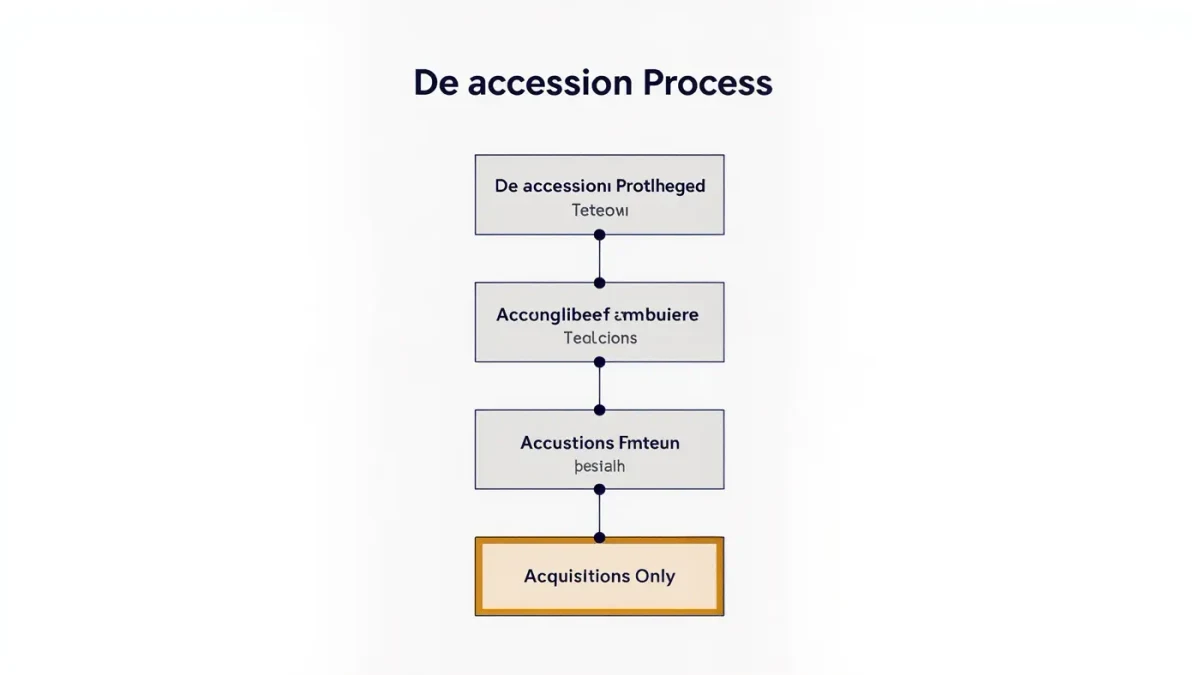
- Curatorial justification memo (redundancy, off-mission, condition).
- Title and donor-restriction review; legal clearance.
- Director endorsement and board vote to deaccession.
- Disposal method chosen — auction, private treaty sale, or transfer.
- Proceeds restricted to acquisitions (or, under AAM’s code, direct care).
- Public disclosure; AAMD registry reporting.
Why Auction Houses Love Museum Deaccessions
Because provenance sells. A work with a named museum in its history carries an implicit authenticity guarantee and institutional polish, and deaccession sales often outperform estimates as collectors bid for ex-museum trophies. That premium is also the corrupting incentive: the better museums’ works sell, the more tempting the collection looks as a balance-sheet asset — which is precisely why the field polices the proceeds rule so jealously.
Frequently Asked Questions
Is deaccessioning illegal?
No — it is a normal collections-management tool. What is prohibited, by professional ethics codes rather than statute, is using the proceeds for anything other than acquisitions (AAMD) or acquisitions and direct care (AAM). State attorneys general can and do intervene when charitable trust obligations are breached, as in the Berkshire Museum case.
Can a museum sell art to pay staff?
Not without consequence. Under AAMD rules it invites censure and loan suspensions; under most interpretations of charitable trust law it invites the attorney general. The 2020–22 pandemic window allowed direct-care uses under AAMD’s temporary policy, but operations remained off limits.
What happened to the Berkshire Museum’s Rockwells?
After the Massachusetts attorney general intervened, the museum sold fewer works than planned, and the two Norman Rockwell paintings went to other museums — honoring, at least partially, the donor intent of an artist who gave them to Pittsfield specifically. The museum remained under AAMD sanction.
Do donors have a say when a gifted work is sold?
Restrictions written into the deed of gift bind the museum; unrestricted gifts leave it free to deaccession. Heirs sometimes object publicly, and museums often seek family consent as a courtesy even where none is legally required.
Why do ex-museum works sell well at auction?
Institutional provenance functions as an authenticity endorsement and a status marker — collectors like walls with museum histories. That premium is real, and it is exactly why the ethics rules focus on proceeds rather than on the sale itself.