An MFA from a top American program now costs, all-in, comfortably into six figures — tuition at elite private schools runs well past $60,000 per year before living expenses in New York or Chicago. What it buys is not a price bump at auction. It buys two years of crits, a peer cohort, and proximity to the faculty and visiting critics who function as the art world's informal casting directors. The market data on MFA graduates' prices is thin and mostly anecdotal; the career data says the degree opens doors, slowly, for a minority — and everyone involved should be honest about the arithmetic.
What Does an MFA Actually Cost?
Two years of tuition plus living expenses at a top private program can total $150,000–$250,000, financed largely through federal and private loans. Public and funded programs invert the math.
The spread between programs is the story. A handful of programs — historically including fully funded situations at public universities and private schools with deep fellowship budgets — pay tuition and a stipend, accepting smaller cohorts in exchange. These are disproportionately competitive precisely because debt-free degrees exist elsewhere in the same field. At the unfunded end, artists leave school carrying loan balances that would strain a law graduate, into a field where the median artistic income is low and unstable. The rough professional consensus: the same degree costs different careers depending on who paid. Debt of that size quietly forces graduates toward salable, mid-size, living-room-friendly work faster than their unindebted peers — a market pressure nobody puts in the brochure.
Do Top Programs Give Dealer Access?
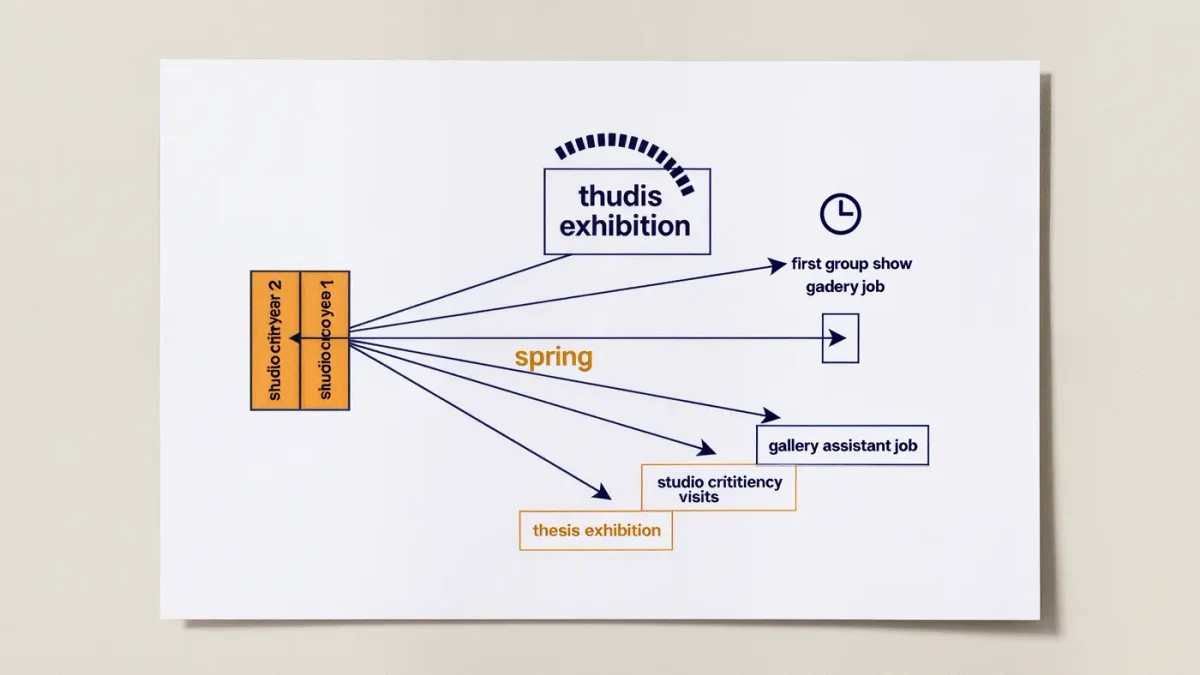
Somewhat, and less than they used to. The mechanism is real but narrow: thesis exhibitions and open studios function as recruiting events, and certain programs have longstanding relationships with particular galleries.
The way it works in practice: dealers with emerging programs send scouts — or go themselves — to the MFA exhibitions of maybe five or six schools nationally. Faculty members, many of whom show at serious galleries, make introductions for the students they rate. Visiting critics, who are often curators and advisors, file names. Over a decade this produces the observable pattern: a visible clustering of top-program graduates in certain galleries' rosters. What it does not produce is a pipeline in any contractual sense. Most MFA graduates of every program, including the most prestigious, never sign with a commercial gallery that matters to their career. The degree widens the aperture; it does not push anyone through.
| What the MFA offers | Strength of market effect |
|---|---|
| Peer cohort and future collaborators | High, compounds for decades |
| Faculty introductions and studio visits | High for a minority of students |
| Thesis show visibility | Moderate, concentrated in a few programs |
| Teaching qualification | High — the MFA is the terminal credential for art teaching |
| Direct price premium on works | Weak to none |
What Do We Know About Prices of MFA Graduates?
Honestly: less than the discourse implies. There is no rigorous dataset tracking graduate prices against non-graduates, and anyone quoting precise comparative figures is guessing. What market observers generally report is directional.
Galleries pricing a debut solo show do not add a premium for the alma mater; they price the work and the program's confidence in it. Where the degree surfaces indirectly is in access — graduates of certain programs get seen earlier, and being seen earlier means first sales earlier, which in a ladder market means higher prices earlier. That is an access effect, not a diploma effect. It is also worth stating the reverse case plainly: a substantial number of commercially successful and historically significant artists never completed an MFA, and several of the market's most expensive names are famously self-taught or dropped out. The market, in the end, prices the work and the story around the work. The CV line helps the story get read; it does not substitute for the work being wanted.
What Are the Alternatives?
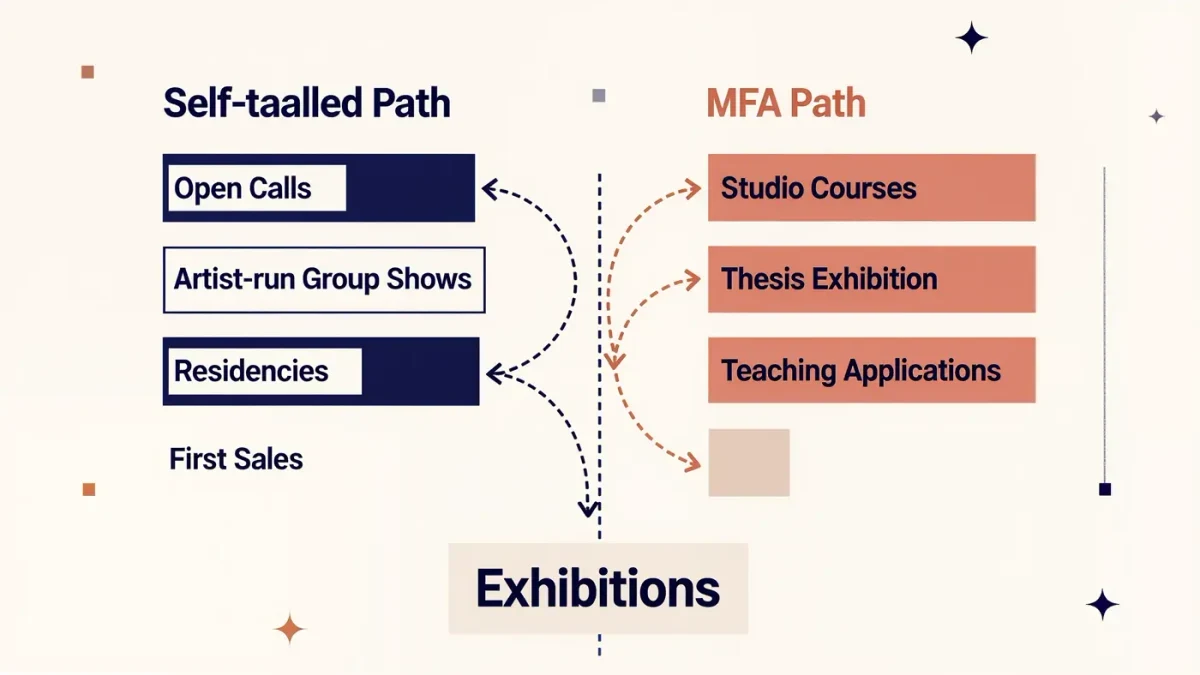
The serious ones are cheaper and slower. Residencies — many free, some paying — deliver visiting critics, cohort, and studio at zero tuition. Assistantships in established artists' studios pay while teaching fabrication and the actual economics of a professional practice. Self-organized exhibitions, artist-run spaces, and the open-submission ecosystem build the sales history that galleries actually read.
The honest framework is not MFA versus nothing. It is MFA versus two years and $200,000 deployed otherwise: residencies, a cheap studio in a secondary city, a body of work, and disciplined applications. For some practices — theory-heavy, institutionally legible, conversation-dependent — the MFA environment is genuinely formative, and the teaching credential alone can justify it, since college-level art teaching requires the terminal degree. For makers whose work needs time and square footage more than seminars, the alternative route has produced plenty of careers. The decision hinges on what the practice runs on: discourse or production. Buy the degree for the discourse, not for the market.
Is the MFA Bubble Real?
The enrollment correction is. The number of MFA programs expanded aggressively through the 2000s and 2010s, and the combination of rising tuition, remote-learning fallout, and visibly weak academic job placement has put pressure on the smaller and less funded end of the market. Applications to top programs remain strong because those programs still deliver the access good; the squeeze is in the middle, where the degree costs as much but confers little network. Prospective students should read a program's recent placement — where alumni are showing, who is teaching, what funding exists — with the same coldness they would apply to any other six-figure investment. The art world romanticizes the studio; it does not extend the same romance to loan statements.
FAQ
Do galleries pay more for MFA graduates' work?
No direct premium exists. Dealers price the work, not the diploma. The degree's market effect is indirect: top programs get graduates seen earlier, which in a ladder market can mean earlier first sales — an access effect rather than a credential effect.
Which MFA programs are fully funded?
A minority, concentrated in programs with deep fellowship budgets and public universities with strong support. Funding is the single most important financial variable: identical degrees produce very different careers depending on whether the graduate carries six figures of debt.
Can you build a career without an MFA?
Easily demonstrated — many commercially and historically significant artists never completed one. Residencies, assistantships, and artist-run exhibition ecosystems substitute for the network. The MFA remains essential mainly for college teaching careers.
Is an MFA worth the debt?
For most graduates, purely on market terms, no — the degree does not reliably generate the income to service six-figure loans. It can be worth it for funded students, for teaching ambitions, or for practices that genuinely develop through critical discourse.
Do thesis shows lead to gallery representation?
Occasionally. Dealers do scout a small number of programs' thesis exhibitions, and a minority of graduates sign from them. Most representation emerges years later through the slower channels of studio visits, introductions, and exhibition history.