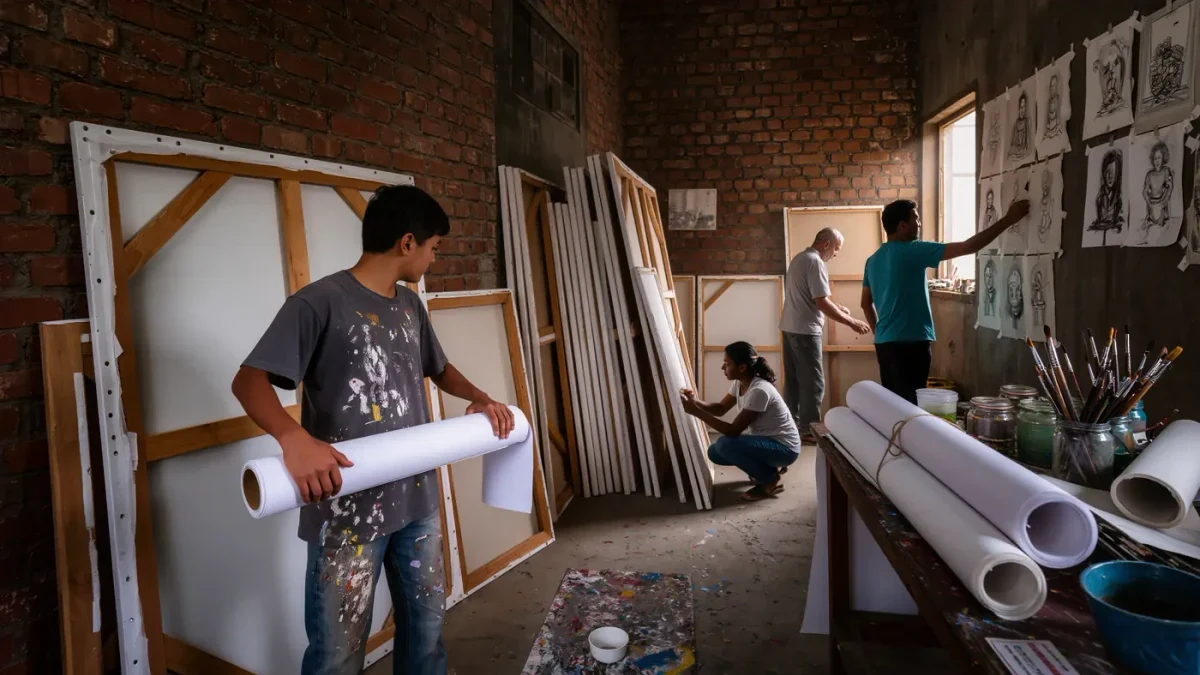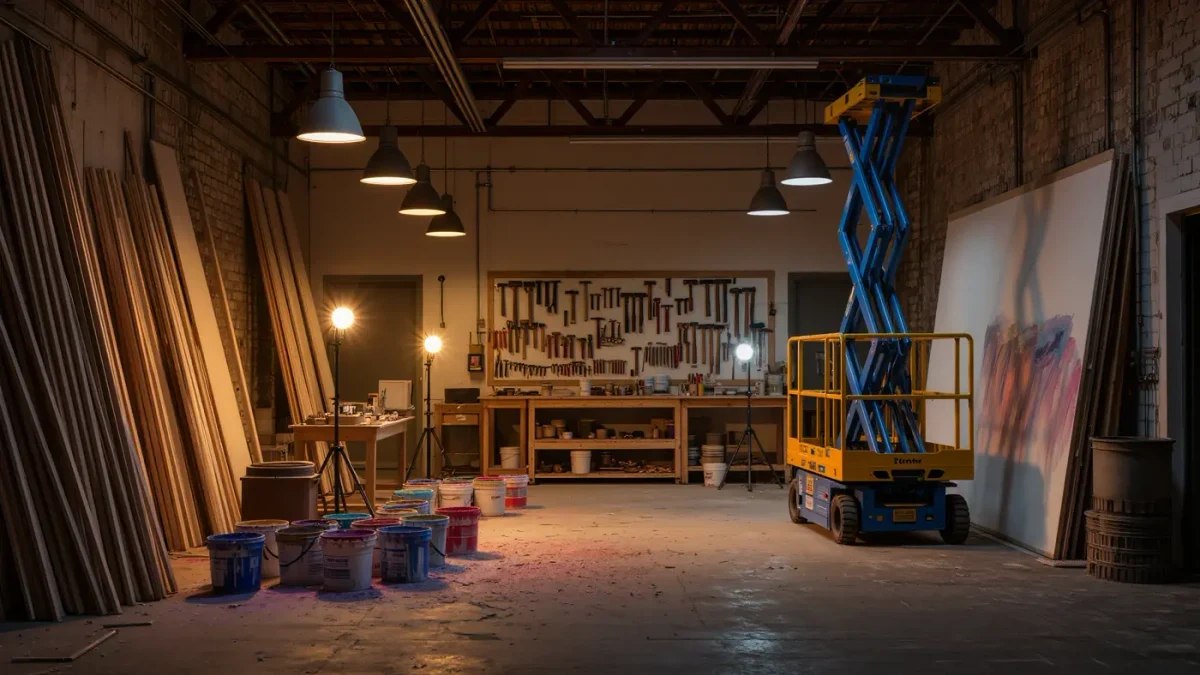
The typical emerging artist's studio costs a few hundred dollars a month — a corner of a shared space, maybe a bedroom wall — while a name-brand practice with assistants, fabrication, and a warehouse in a major art capital can run to several hundred thousand dollars a year in overhead before a single work is sold. Between those poles, the economics of making art transform in kind, not just degree: every step up in scale adds fixed costs, labor, and coordination, and the margin on each work has to restructure to carry them. The romance of the studio ends where the spreadsheet begins.
What Does Studio Space Actually Cost?
Rent is the silent partner in every artist's business, and it scales superlinearly with career success. In New York or London, a liveable practice space runs from a few hundred dollars for a shared sublet to five figures monthly for a serious warehouse.
The geography is the strategy. Artists have historically chased cheap industrial space — SoHo lofts in the 1960s, then Williamsburg, then Bushwick, then beyond the city entirely, in a repeating wave that landlords ride and artists create. The pattern is so reliable that studio-gravity now shapes whole neighborhoods before the market notices. Mid-career artists in expensive cities commonly relocate production to the periphery or to lower-cost regions and keep only a presentation studio near the gallery district. The other escape routes are institutional: subsidized studio programs run by nonprofits and municipalities offer below-market space by lottery, and residencies provide temporarily free square footage. The arithmetic is unforgiving: an artist grossing $40,000 a year from work cannot carry $2,000-a-month rent, which is why the shared studio, the day job, and the out-of-town storage unit are the sector's real infrastructure.
When Do Assistants Enter, and What Do They Cost?
Assistants arrive when demand for output exceeds the artist's hands — and they change the economics of every work touched. Studio assistant wages in major cities typically run roughly $20–$40 an hour, with skilled fabricators and painters commanding more.
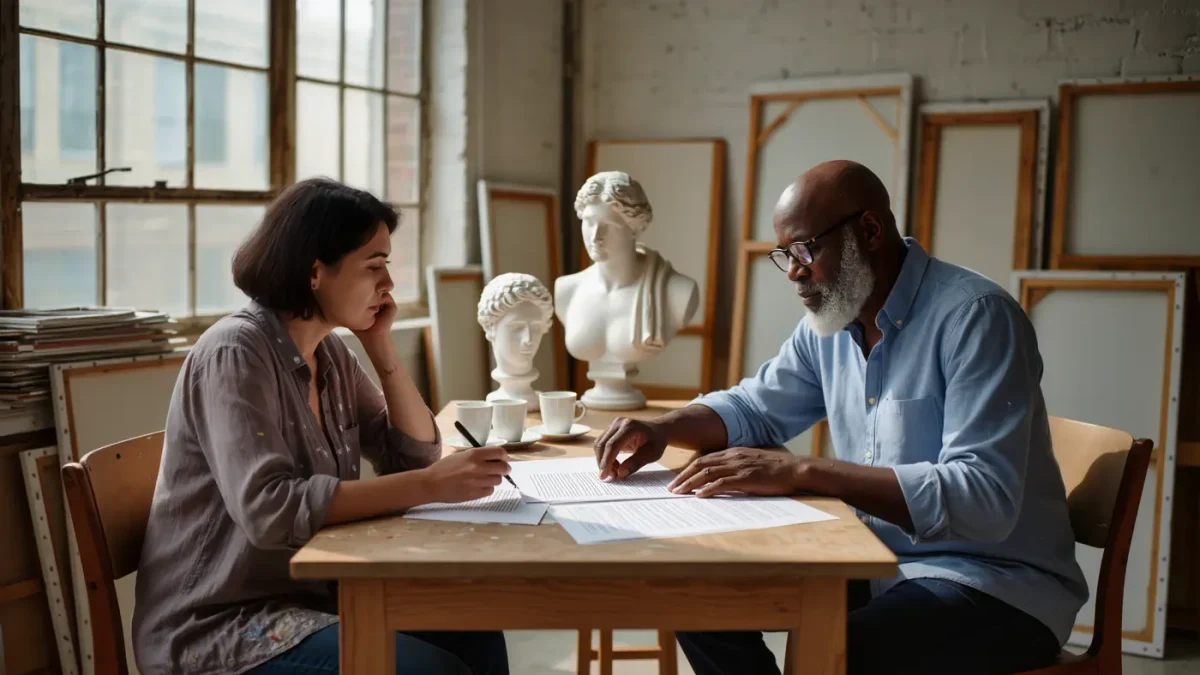
The progression is standard. First a part-time preparator for stretching, priming, packing. Then a studio manager who also handles logistics, archives, and shipping. Then specialized fabricators for a practice that has drifted toward delegation — large paintings executed to spec, sculptures engineered and cast externally. At the top end, the studio becomes a small firm: a director, several assistants, an archivist, external fabrication contracts. The labor economics bite differently at each stage. A painting that took the artist a month unassisted had one cost structure; the same-format painting executed by two assistants under supervision has another, and the artist's fee shifts from wage to royalty on their own brand. This is where the older romance of the solitary hand collides with contemporary practice: much of the art in fairs' top tiers is produced by teams, priced accordingly, and the market has long since stopped pretending otherwise.
How Do Materials and Fabrication Scale?
Materials are the most visible cost and, at the top, among the least consequential. Cadmium pigment and Belgian linen hurt at the $5,000-painting tier; at $500,000, materials are a rounding error.
| Practice scale | Typical monthly overhead | Dominant cost |
|---|---|---|
| Emerging, shared studio | $300–$1,500 | Rent share |
| Mid-career, own space | $2,000–$8,000 | Rent, materials, part-time help |
| Established, small team | $10,000–$40,000 | Salaries, fabrication |
| Top-tier studio-firm | $50,000+ | Payroll, facilities, production contracts |
Fabrication-heavy practices — bronze, large-format photography, complex installation — behave like light manufacturing: capital costs up front, per-unit costs that fall with volume, and catastrophic cash-flow timing, because galleries pay months after materials invoices come due. The working-capital problem is the studio economy's open secret: an artist can be profitable on paper and insolvent by calendar.
How Does Scale Change the Unit Economics of a Work?
Work backward from a gallery's 50/50 split. At the emerging tier, a $6,000 painting leaves the artist roughly $3,000, minus perhaps $600 in materials and a painful fraction of a month's rent: call it $1,500–$2,000 net for a month of labor. That is a waiter's wage with worse hours.
At the established tier, the arithmetic inverts. A $60,000 painting leaves $30,000, of which perhaps $8,000 covers allocated studio overhead and assistant time — leaving a margin above 50%. Scale does not just increase income; it increases the margin on each work, because overhead amortizes across a higher price base while the market pays for the name, not the hours. This is the real economic engine beneath the price ladder: prices must rise partly to fund the infrastructure that a serious practice requires, which is why mid-career artists who stall at modest prices are squeezed hardest — too successful for the cheap studio, not successful enough for the margin structure. The death zone of the art economy is the middle.
How Do Artists Actually Finance the Gap?
Rarely from sales alone. The composite income of the professional artist is a braid: sales, teaching, grants, commissions, and day jobs, with public-art commissions and residencies functioning as the most reliable cash injections. Grants and prizes — from foundations, arts councils, and biennials — are effectively the sector's venture capital, non-dilutive and prestige-bearing. Teaching provides the stable core: a tenured or adjunct position carries the rent so that sales income can be reinvested in production. The artists who manage decades-long careers are, more often than the myth admits, competent operators who treat the studio as a business with a strange revenue model — because that is what it is.
FAQ
How much does an artist studio cost per month?
From a few hundred dollars for a shared space to five figures for a major practice in New York or London. Most emerging artists spend $300–$1,500 monthly; rent is typically the largest fixed cost and the reason artists cluster in cheap industrial districts that later gentrify.
What do studio assistants earn?
Roughly $20–$40 an hour in major art capitals for general studio work, more for skilled fabricators. Teams arrive gradually — preparator, then studio manager, then specialists — and at the top end payroll becomes the studio's dominant expense.
Do successful artists still make their own work?
Many do; many don't. Delegation is a long-standing, accepted studio model — teams execute work to the artist's spec, as workshops historically did. What matters commercially is authorship and consistency, not solitary labor, though some artists make hand-production part of the work's value explicitly.
Why are mid-career artists financially squeezed?
Because overhead arrives before margins. A serious studio needs space and help before prices rise enough to amortize them, so artists who stall at modest prices carry top-tier costs on emerging-tier revenue. The middle of the market is the least forgiving place to be.
How do artists cover cash-flow gaps?
Through a braid of income: teaching, grants, commissions, public art, and day jobs alongside sales. Grants and residencies function as the sector's non-dilutive venture funding, and teaching often carries the fixed costs so sales revenue can be reinvested in production.