Emerging artist pricing usually starts between roughly $2,000 and $10,000 for a first gallery show, and the number is set by the dealer, not the artist. That corridor — low four figures for works on paper and smaller canvases, stretching toward five for a debut with a serious program — is less about talent than about what the market will absorb without flinching. Price a debut too high and the work sits; price it too low and the artist gets locked into a discount reputation that takes years to escape.
Who Actually Decides the Price of an Emerging Artist's Work?
The gallery decides, in nearly every case. A dealer bringing an artist into the primary market is making a pricing bet with their own client list, and they treat the first figure as a positioning statement.
Artists arriving from an MFA program or a first residency often imagine a negotiation. In practice, the dealer calculates: size of the artist's output, exhibition history, whether any institutions have bought or shown the work, what peer artists at comparable galleries charge, and how fast the program expects to move the inventory. The artist's own sense of what a painting is worth — hours, materials, emotional investment — enters the equation last, if at all. That is not cruelty; it is how a dealer protects the artist's long-term ladder. A first price is a foundation, and foundations that are too high cannot be quietly lowered later without embarrassing everyone involved.
Self-represented artists do set their own numbers, and the market usually tells them they were wrong. Direct sales priced at gallery levels without gallery infrastructure tend to stall, which is why the studio-sale price is typically discounted against what a dealer would charge for the identical object.
What Is the Typical Corridor for First Sales?
Think in tiers, and think in objects. The corridor moves with medium, scale, and venue.
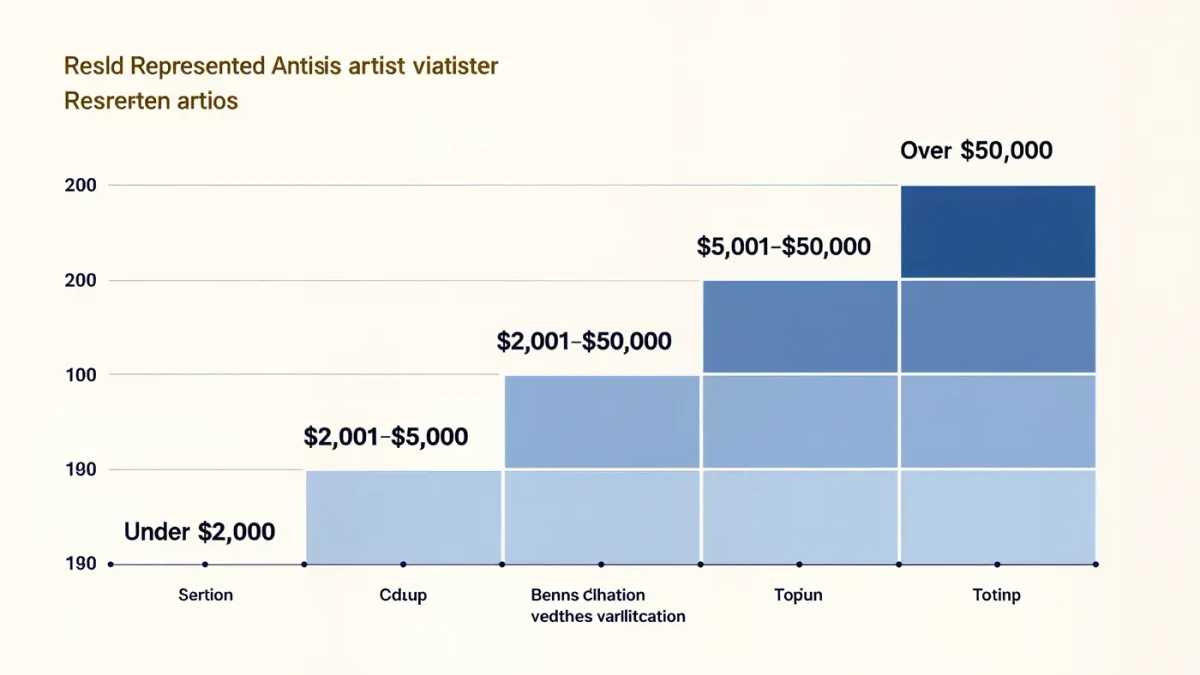
Works on paper, photographs, and small editions from artists with no sales history commonly sit in the $1,000–$5,000 range. Paintings and unique sculptures from a first solo show at a credible commercial gallery generally run $4,000–$15,000, with the top of that band reserved for programs in New York, London, or Los Angeles with waiting-list dynamics. A debut at a blue-chip-adjacent gallery — rare, but it happens — can open above $20,000, because the dealer is selling the gallery's own scarcity as much as the artist. Fair debuts, especially in curated emerging sections like Frame or Positions-style platforms, often push the top of the band: fair collectors expect to pay a premium for the convenience.
| Career stage | Typical unique-work range | Typical venue |
|---|---|---|
| Pre-gallery, studio sales | $500–$3,000 | Open studios, degree shows |
| First group shows | $1,500–$6,000 | Small commercial galleries, nonprofits |
| First solo show | $4,000–$15,000 | Established emerging program |
| Second market (fairs, secondary buzz) | $10,000–$40,000 | Art fair sections, secondary bids |
How Do Prices Rise Between Markets?
Price increases are earned in steps, and each step is a different market signaling to the next one. The classic sequence runs studio to gallery to fair to auction, and each hop carries its own logic.
A gallery raises prices by roughly 25–50% per cycle — per solo show, roughly every 18 to 24 months — as long as the previous show sold through. A sell-out debut at $8,000 justifies a second show at $11,000; two sold shows plus institutional interest justify the fair premium. The auction hop is the dangerous one. When a work by a young artist appears at auction and outruns the primary price, the gallery raises primary prices to close the gap — but if the hammer stalls below estimate, the artist's carefully built ladder can collapse in an afternoon. This is why dealers fight so hard to keep young work off the block and why they track first-time auction results with the attention of bond traders.
- Studio to gallery: the dealer adds margin, context, and typically a 50/50 split of the retail price.
- Gallery to fair: a premium of 10–30%, reflecting collector competition and stand costs.
- Primary to secondary: set by auction results and dealer demand, no longer by the artist's camp at all.
Why Do Galleries Guard Low Starting Prices So Carefully?
Because the only thing worse than an unsold painting is an artist who cannot go up. The primary market runs on the perception of a trajectory, and trajectories have to start low enough to leave room.
Dealers describe first pricing as building a staircase. Each step must be defensible to collectors who bought at the previous step — nobody wants to have bought at $9,000 only to see the same artist's similar work offered to someone else at $9,500 a year later with no news in between. Sales history, museum acquisitions, biennial selections, critical press: these are the justifications that make each increase feel earned rather than opportunistic. A young artist who raises prices without external validation gets flagged by advisors, and advisors are the immune system of the collector class. The smartest emerging programs inflate slowly and sell out consistently, because a sold-out show at a modest price is worth more reputational capital than a half-sold show at an ambitious one.
What Role Do Materials and Size Play?
A real one, though smaller than artists hope. Size is the primary market's crude unit of account: dealers price per dimension band, not per hour, which is why the 3-meter canvas costs four times the 1-meter one even though it took twice as long.
Medium carries its own hierarchy. Painting commands the deepest market, followed by sculpture, which carries fabrication costs that eat margins. Photography and print editions spread a lower price across a run of buyers, which is why editions have long been the entry product for young programs. Production-heavy practices — bronze casting, large-format printing, fabrication shops — can leave an artist with a thin slice of a nominally healthy price, a problem that becomes acute once assistants and studio rent enter the picture. The artist's real take from a $10,000 sale, after a 50% split and production costs, can be startlingly modest. Emerging economics are a volume business disguised as a luxury one.
Can an Artist Reset a Price That Was Set Too Low or Too High?
Up is manageable; down is brutal. Prices that started too low can climb quickly with a couple of strong shows, a wait list, and a new, more ambitious gallery. Prices that started too high have no dignified exit — a discount is read as weakness, and unsold inventory becomes the market's evidence.
The cleanest reset mechanism is the edition or the work on paper: a lower-priced object class lets a program recalibrate demand without touching the headline painting price. The second mechanism is geography — an artist whose prices outran their home market sometimes finds a more forgiving collector base abroad. The third is time, which is what most artists get. The uncomfortable truth of emerging pricing is that the first number is mostly a bet on the dealer's client list, and the artist's job is not to set the figure but to make the dealer's bet look conservative two years later.
FAQ
Do emerging artists keep half of the gallery price?
Usually, but only after the split. The standard primary-market arrangement is 50/50, and the artist's half is then reduced by materials, fabrication, and studio costs. On a $6,000 painting, the artist's net can land under $2,500 before taxes — which is why volume and price growth matter more than any single sale.
How fast can an emerging artist's prices double?
Two to four years is a realistic fast track, driven by sold-out shows, institutional acquisitions, and auction heat. Doubling within a single cycle happens, but it usually requires external validation — a biennial, a museum purchase — rather than dealer enthusiasm alone. Outpacing the evidence is how young markets break.
Are art fair prices higher than gallery prices?
Often, by 10–30%. Fairs concentrate motivated collectors in one room, and dealers price the urgency. Some programs hold prices flat for fairness; others openly charge a fair premium. Buyers who want the same artist cheaper can usually wait for the gallery show — if the work lasts that long.
Should a young artist sell directly from the studio?
Before a gallery relationship, yes — studio sales build a collector file and a sales history. After signing, almost never at retail-comparable prices, because undercutting the gallery poisons the relationship that sets the artist's entire price ladder. Discounted studio sales also leak, and collectors talk.
What single factor most reliably raises an emerging artist's prices?
Institutional validation. A museum acquisition or a curated biennial slot does more for the price ladder than any amount of press, because it converts a dealer's claim into a public fact. Everything else — buzz, social following, auction speculation — is faster but more fragile.