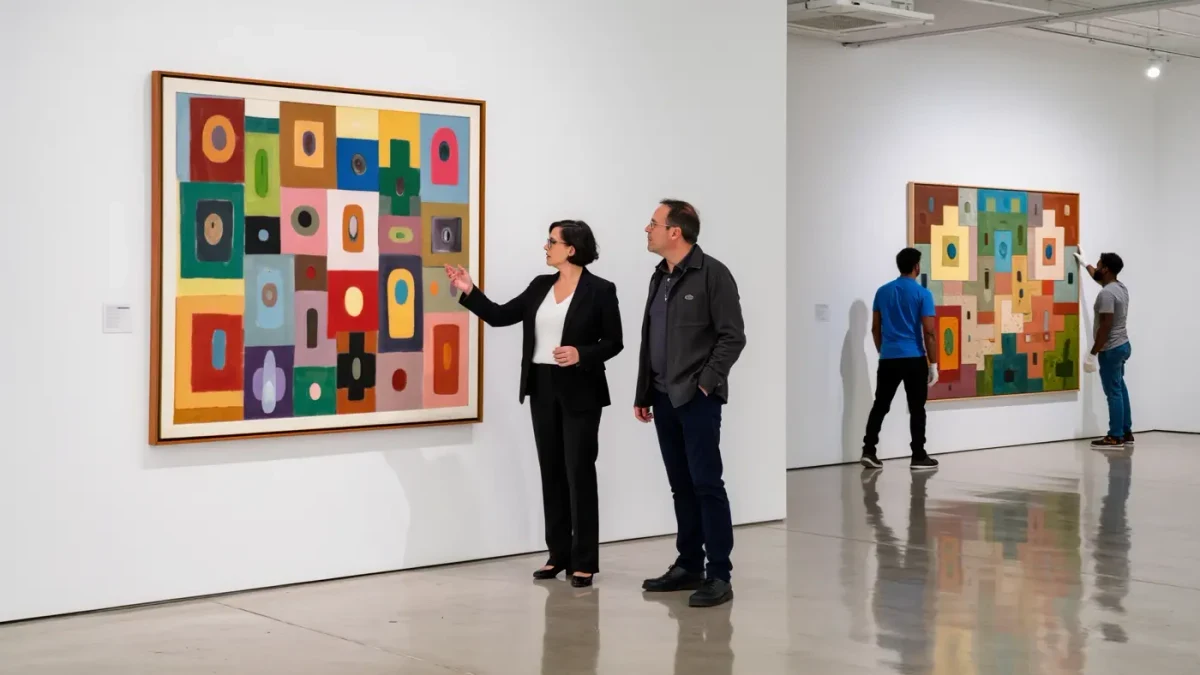
How do commercial art galleries work? On the surface, a gallery sells artworks; underneath, it is a consignment business that typically splits the retail price with the artist roughly 50/50, finances production, fairs and catalogues out of its own half, and bets on a roster of twenty or so careers appreciating like a private equity portfolio. The model has barely changed since Leo Castelli and Sidney Janis ran Fifth Avenue-era programs in the 1950s and '60s. What has changed is the burn rate.
What Is the Standard Gallery Business Model?
The core of the model is consignment: the artist retains ownership of the work until it sells, and the gallery acts as exclusive agent. When a painting priced at $20,000 finds a buyer, the artist customarily receives 50 percent and the gallery keeps 50 percent. The split is an industry norm rather than a law, and it flexes — anything from 40/60 in the artist's favor for a star to 60/40 in the gallery's favor when it has heavily financed production, but 50/50 is the number dealers and artists quote by default.
That half is not profit. It funds rent on street-level or second-floor space in New York, London or Paris, salaries for directors and registrars, insurance, shipping, installation, photography, exhibition catalogues, champagne on opening night and, above all, art fair booths — industry estimates routinely put a mid-career gallery's annual fair budget in the low millions of dollars. A gallery is best understood as a venture fund whose portfolio is people: it subsidizes a dozen unprofitable early careers in the hope that two or three become market-defining names whose secondary prices retroactively validate the whole program.
Why Do Galleries Take 50 Percent?
Because the commission is not a sales fee — it is the price of an entire career apparatus. A serious gallery pays for a physical program of six to ten exhibitions a year, placement of works into museum shows and important private collections, art fair participation across Basel, Frieze and their regional equivalents, and the slow construction of an artist's market history. Consign a painting to an auction house instead and you may pay a comparable buyer's premium on the other side of the transaction, but nobody will fly to your studio, place your sculpture into a biennale or defend your pricing when the market wobbles.
The split also insures the gallery against the fact that most inventory does not sell. A typical exhibition might place half its works in a good season; the rest returns to storage at the gallery's expense. Dealers argue the 50 percent amortizes the failures. Artists, notably those leaving galleries over the years, argue the reverse — that the commission has stayed flat while galleries do less artist development and more fair-driven volume. Both things are true at once, which is the art market's usual condition.
| Where the gallery's 50% goes (typical mid-size program) | Rough share of revenue |
|---|---|
| Art fairs: booths, shipping, travel | 25–35% |
| Rent and facilities | 10–15% |
| Staff payroll | 15–25% |
| Production advances and catalogue costs | 5–15% |
| Insurance, storage, installation, misc. | 5–10% |
Shares vary wildly by city and ambition, but the pattern holds: fairs and fixed costs together consume the majority of the gross before the owner takes a dollar.
How Does Consignment Work in Practice?
Consignment means the gallery never buys the work — it borrows it, markets it and remits the artist's share, usually 30 days after payment clears, net of any agreed discounts. The artist keeps title, carries the copyright and can expect the work back if it doesn't sell within the exhibition cycle. In the United States, consignment relationships are protected by state laws (New York's Arts and Cultural Affairs Law among the strongest) requiring written agreements and treating consigned works as trust property of the artist — a protection that matters most when a gallery fails, as hundreds did after 2008 and again in 2020.
The consignment structure also explains a gallery's cash-flow weirdness. Inventory costs nothing to acquire but everything to move, insurance and store. Revenue is lumpy, concentrated in two or three fair weeks a year. And the most valuable thing on the balance sheet — future access to a sought-after artist's new production — cannot be collateralized at any bank. This is why galleries die suddenly and quietly, and why artists' unpaid consignments are usually the largest creditor claims when they do.
What Services Does a Gallery Actually Provide?
The service stack is broader than retail. A gallery prices and paces an artist's primary market, withholding works and staging scarcity. It places pieces with collectors and institutions whose ownership adds resale value — the soft science of provenance-building. It advances production costs for ambitious projects, absorbs catalogue deficits, lends works to museum shows at its own logistics cost, and defends the price line on the secondary market by buying works back at auction when estimates threaten to undershoot the primary price. None of this appears on an invoice; all of it is what the 50 percent nominally buys.
The counter-service is control. Exclusive representation, usually by territory or worldwide, means the artist cannot sell from the studio at undercutting prices without corroding the trust that underwrites everything else. Discount discipline runs the same way: a 10 percent courtesy discount to a museum curator is standard, a quiet 30 percent to a flipper is a small scandal, because the next buyer reads the real price off the last one.
Primary, Secondary and the Hybrid Program?
Primary sales are first-sale works from living artists' studios — the gallery's margin-rich but slow core. Secondary sales are resales of any work the market recirculates, where the gallery acts as a private dealer between two owners, takes a similar commission and competes with auction houses. Most surviving galleries now run both: secondary inventory smooths the cash flow between primary seasons, and access to an artist's older works lets the gallery manage its price history like a central bank manages interest rates. The hybrid is no longer opportunism; it is the business model.
How Do Galleries Survive When Sales Slow?
Badly, and then creatively. The classic levers: more fairs (expensive), more secondary trading (margin-rich), advisory services for collectors (fee income), editioned and lower-priced works to widen the buyer funnel, and eventually — as Gagosian, Zwirner and Hauser & Wirth have all done — global expansion to wherever the collectors are. Industry estimates suggest a majority of small galleries operate at break-even or a loss in weak years, subsidized by owner capital or secondary deals. The structural answer, increasingly, is scale: the top twenty global galleries now capture a disproportionate share of total gallery revenue, and the middle keeps thinning.
What hasn't changed is the underlying wager. Galleries remain leveraged bets on taste — illiquid, reputation-denominated, and occasionally spectacular when a $10,000 consignment from a decade ago trades at $2.3 M. on the secondary market with the gallery's original invoice as the first line of its provenance.
FAQ
Do artists get 50 percent of every sale?
The 50/50 split is the industry norm for primary sales, but contracts range from 40/60 to 60/40 depending on the artist's leverage and how much the gallery financed. Secondary-market resales have no fixed artist share in the U.S., while U.K. and E.U. sellers pay a statutory resale royalty.
Who owns the artwork while it sits in a gallery?
The artist does. Under consignment, the gallery holds work as agent, not owner, and U.S. state consignment laws typically treat it as trust property of the artist. If the gallery goes bankrupt, properly documented consigned works are supposed to return to the studio rather than the creditors.
Why don't galleries just buy work from artists and resell it?
Some do — outright purchase shifts inventory risk to the gallery, so most prefer consignment's capital-light structure. Consignment also keeps the artist's incentive aligned: both sides profit only when the work actually sells at the agreed retail price.
How do galleries make money between exhibitions?
Through art fairs, secondary-market private sales, editioned works and advisory fees. A typical program now earns well under half its revenue from its own exhibitions — the Chelsea or Mayfair space functions partly as branding infrastructure for sales that happen elsewhere.
Is a gallery a good business to start?
It is a low-margin, high-fixed-cost business with long payback cycles and heavy dependence on artist loyalty and fair participation. Most new galleries take years to reach profitability and fail on cash flow rather than taste — the graveyard is full of programs with excellent rosters.