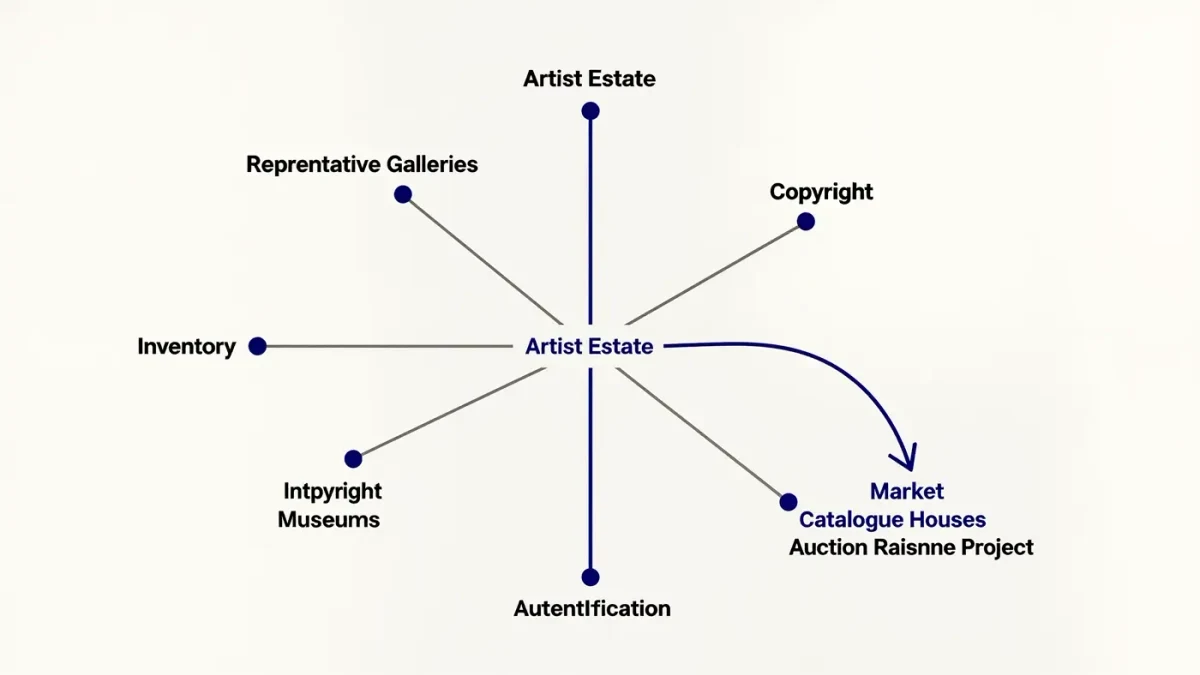
What happens to an artist's market when the artist dies? It becomes someone's job. Artist estates — foundations, trusts, or heirs acting together — inherit not just inventory but the market itself: the power to release or withhold work, to authenticate, to license and to choose the galleries that will represent the oeuvre for decades. The representative gallery for a major estate controls supply to the primary pipeline of the secondary market; the classic example is the decades-long relationship between the Agnes Martin estate's handling and David Zwirner's posthumous construction of her market, or, structurally, the Andy Warhol Foundation's licensing-and-authentication regime. Death, in this market, is a corporate event.
Why Does an Estate Need a Gallery at All?
Because a dead artist cannot do the things a living one does incidentally: pace supply, place works, endorse exhibitions and add new market history. The estate's gallery (or partner galleries) performs the representation function posthumously — organizing exhibitions that refresh scholarship, placing estate inventory with museums and serious collectors, coordinating with auction houses on what reaches public sale, and defending the price line. The commercial logic inverts on death: a living artist's market produces new supply; an estate's market manages a fixed one, which makes scarcity the estate's principal asset and its principal temptation to spend.
The choice of gallery is therefore strategic, not sentimental. Estates typically weigh a gallery's museum relationships, its record with comparable posthumous markets, its international reach and — increasingly — its willingness to coordinate with rather than simply exploit the estate's inventory. Multiple-gallery structures are common: one gallery for New York, another for Europe, each with defined inventory and pricing coordination.
How Does the Selection Process Work?
There is no open tender; the process is courtship in both directions, and usually begins before the artist's death (the strongest positions come from galleries that represented the artist while alive, having built the market they now inherit a share of). A typical sequence:
- The estate's board or heirs define priorities: income for heirs, museum placement, scholarship, or legacy control.
- Candidate galleries are evaluated on museum relationships, posthumous-market track record and alignment with the estate's pacing philosophy.
- Terms cover commission on estate sales (commonly in the 20–30 percent range for consigned inventory, below living-artist splits), exclusivity scope, exhibition commitments and auction coordination.
- Authentication and catalogue raisonné responsibilities are assigned or reserved — the estate's most jealously guarded power.
How Do Estates Manage the Secondary Market?
Carefully, and with mixed success. The estate controls only what it owns: unsold studio inventory, copyright and (where applicable) authentication. It cannot stop collectors from reselling, but it can shape the resale environment — releasing inventory gradually to keep prices firm, buying works back at auction when estimates threaten the market, feeding museum shows that re-rate the oeuvre, and licensing reproductions to keep the name in circulation. The fixed supply is the structural advantage: no new works can dilute the market, so disciplined estates see posthumous prices rise steadily as museums absorb supply permanently. The undisciplined see the opposite — a rush of heir-motivated selling that trades legacy for liquidity and marks the market down for a generation.
Authentication is the era's defining estate problem. U.S. estates and foundations retreated from authentication boards after litigation exposure — the Warhol Foundation famously dissolved its authentication board in 2012 amid lawsuits — leaving catalogue raisonné projects, scholar consensus and, in practice, dealer warranty as the remaining mechanisms. A representative gallery's opinion carries weight precisely because it stands behind its attributions commercially.
What Are the Common Estate Structures?
| Structure | Typical use | Market function |
|---|---|---|
| Heirs / family trust | Smaller estates | Direct control; variable expertise |
| Nonprofit foundation | Major U.S. estates | Holds inventory and copyright; grant-making; tax efficiency |
| Estate + partner gallery or galleries | Nearly all | Representation, placement, exhibitions |
| Catalogue raisonné project | Scholarly estates | De facto authentication authority |
The U.S. private foundation has been the preferred vehicle for large estates since the 1970s–90s wave (Pollock-Krasner, Warhol, Lichtenstein among the exemplars), trading heir liquidity for mission-driven market stewardship — a bargain the IRS watched closely enough that foundation rules on holdings and sales materially shaped estate strategy.
The copyright tail matters commercially as much as the inventory. Reproduction and merchandising rights — prints, licensing, museum-shop revenue — can outearn consignment sales for visually iconic estates, and a representative gallery often negotiates licensing deals alongside its sales mandate. This is why estate agreements increasingly read like media contracts, not just consignment terms.
What Can Go Wrong?
Three recurring failures. Supply indiscipline: heirs or a cash-hungry foundation release inventory faster than the market absorbs, printing lower public prices that take decades to recover. Governance capture: estates run as family fiefs make placement and authentication decisions on personal rather than market logic, and the representative gallery spends its political capital managing the family instead of the oeuvre. And the liquidity trap: a foundation's operating costs — staffing a catalogue raisonné, funding grants, insuring warehouses — can force selling at exactly the wrong moments. The well-run estate behaves like a central bank: predictable, boring, allergic to surprises. The market pays a premium for boring.
For younger galleries, estates are a growth strategy with unusual math: the brand arrives pre-validated, museum demand is structurally capped by fixed supply, and the competition is a handful of rivals rather than every new grad show. The last two decades of mega-gallery expansion have been partly a quiet scramble for posthumous rosters — representation of the dead being the only market share that never renegotiates by leaving for another gallery, though it can, embarrassingly, be lost to one.
Tax design shapes everything downstream. U.S. estates face valuation at death — appraisals that galleries' and auction houses' comparables inform — and foundations face payout and self-dealing rules that constrain how inventory can reach market and who may buy it. Estate planning with art is therefore not only a family matter but a market-architecture decision made, ideally, while the artist is alive enough to have opinions about it.
FAQ
Who controls an artist's market after death?
The estate — heirs, a trust or a foundation — holds the inventory, copyright and (where applicable) authentication authority, and appoints one or more representative galleries to manage sales, exhibitions and placement. The estate governs supply; the gallery executes the market.
Do artist estates pay galleries the same commission as living artists?
Generally less: consigned estate inventory commonly carries commissions in the 20–30 percent range rather than the ~50 percent primary split, since the gallery performs placement rather than career-building. Terms vary with exclusivity scope and services.
Why did foundations stop authenticating artworks?
Litigation risk. Lawsuits over rejected attributions made U.S. authentication boards uninsurable in practice — the Warhol Foundation dissolved its board in 2012. Authentication now rests on catalogue raisonné scholarship, expert consensus and dealers' commercial warranties.
Can an estate stop a collector from reselling a work?
No — first-sale doctrine leaves resales beyond copyright control in the U.S. Estates shape the secondary market indirectly: pacing their own releases, buying at auction defensively, funding museum exhibitions that lift the whole oeuvre's standing.
Do artist prices rise after death?
Sometimes, and never automatically. Fixed supply helps disciplined estates, and museum absorption of works can lift values durably. But forced or hasty estate selling has marked down plenty of posthumous markets — death is a re-rating event in whichever direction the estate's management points it.