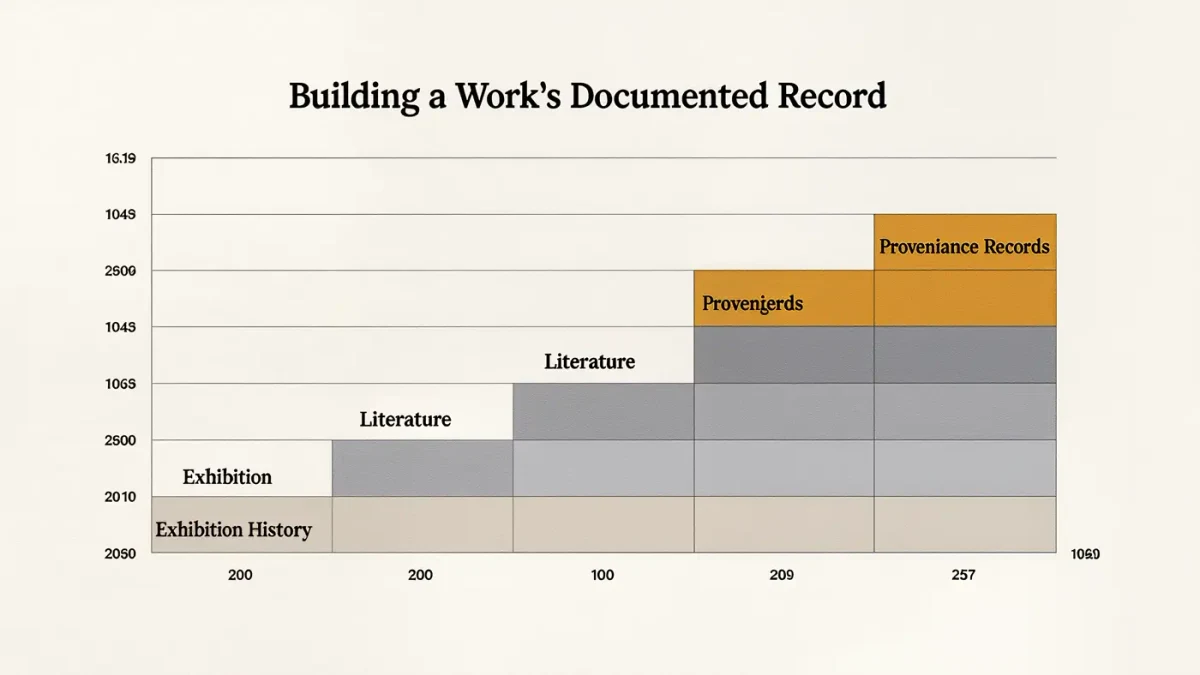
Why should a collector care about exhibition catalogues? Because they are the documentation layer on which art-market value partly rests. A work's entry in the catalogue of a serious museum show — reproduced, catalogued, discussed by a scholar — is permanent evidence that the object passed through institutional hands and critical attention. That evidence follows the work at every future sale: it appears in auction catalogue notes, in appraisal dossiers, in the provenance section of dealer inventories. The catalogue itself is modest paper; the market history it certifies is not, and serious collectors treat assembling documentation with the same discipline as assembling the works.
What Documentation Actually Does to a Work's Record
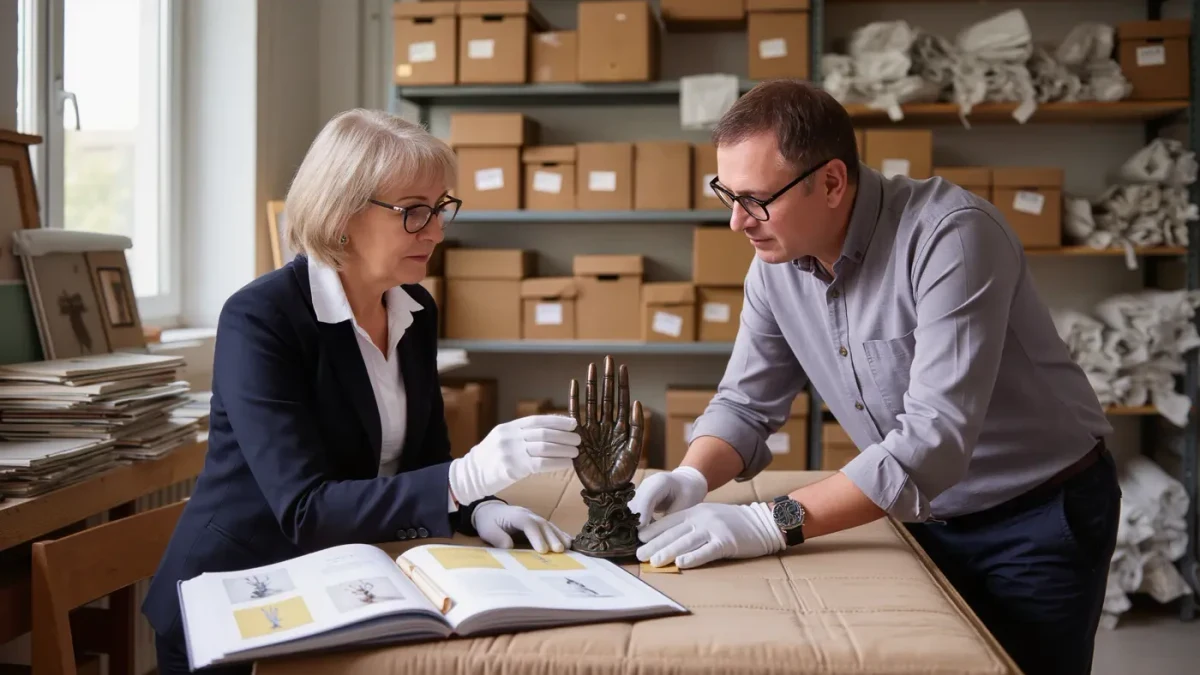
Market professionals speak of a work's file almost as an extension of the object. The file contains provenance, condition history, literature — the publications in which the work has been reproduced or discussed — and exhibition history, the shows in which it has appeared. Catalogues are the durable, citable form of both latter categories: a reference in a 1987 museum catalogue with plate number and page is verifiable forever; a dealer's recollection of a 1987 group show is not. When an auction house writes extensively exhibited and abundantly illustrated, it is translating documentation into price expectations, and the translation is reliable — documented works command stronger results than identical undocumented ones because the buyer's risk is lower.
Documentation also does defensive work. A work with continuous exhibition and literature records is harder to challenge on attribution, easier to insure, simpler to export through jurisdictions requiring cultural-property proof, and faster to place with institutions. The file is the work's résumé, and like all résumés it compounds quietly.
Which Catalogues Carry Weight
The hierarchy is straightforward. Museum exhibition catalogues with new scholarly essays outrank commercial gallery checklist publications; catalogues raisonnés — the comprehensive scholarly compilations of an artist's complete works — sit at the top as the canonical reference. Major-venue trumps regional; hardback with plate numbers and index trumps stapled brochure. First editions of catalogues for historically significant exhibitions have themselves become collectible, trading well above their original cover price — the catalogue of a groundbreaking show is a fragment of the event, and the market for that paper is its own small but real sector.
The Collector's Practical Playbook
- Buy the catalogue when you buy the work. If the piece has appeared in any significant show, own the publication; it is the cheapest provenance enhancement available.
- Lend strategically. Lending a work to museum exhibitions adds exhibition and literature entries to its file — a reason collectors lend without fees, and occasionally quietly subsidize shows their works appear in.
- Keep a dossier per work. Invoices, condition reports, correspondence, installation photographs, every reference that touches the object — assembled while memories are fresh.
- Track new literature. Scholarly interest in an artist generates citations that thicken the files of everything in the corpus; monitoring it is free market intelligence on the artists you hold.
- Transfer the file with the sale. Documentation handed to the next owner raises the work's realized value — and selling without it leaves money on the table.
Documentation as an Asset Class
The catalogue market proper — collecting the books themselves — rewards connoisseurship of the same kind the art market does. Condition matters (mint copies with dust jackets command premiums); completeness matters (multi-volume sets, special editions signed by the artist); scarcity matters (short-run catalogues of historic exhibitions, out of print for decades). Prices for landmark catalogues have appreciated over the long run, though with nothing like the volatility of the artworks they document. The sober framing: catalogues are a portfolio's scholarship, not its engine — but a collector who understands which publications matter usually understands which artists matter, and that knowledge transfers directly.
| Publication type | Function in a work's file | Market weight |
|---|---|---|
| Museum exhibition catalogue | Citable exhibition and literature entry | High, venue-dependent |
| Gallery checklist publication | Confirms exhibition history | Modest |
| Catalogue raisonné entry | Canonical inclusion | Decisive for the artist's market |
| Scholarly monograph reproduction | Literature citation | Strong |
| Auction catalogue entry | Public price record plus scholarship | Corroborative |
How the Trade Uses Catalogues
Watch the professionals, whose behavior reveals the instrument's function. Auction specialists preparing a consignment begin by assembling the lot's literature — every catalogue reference, with page and plate — because the entry writes the provenance and scholarship section that bidders read; a well-illustrated exhibition history is routinely the difference between two estimates for comparable works. Dealers building a private-sale presentation photograph the relevant catalogue pages alongside the work. Appraisers cite literature records in reports precisely because they are third-party, dated and verifiable — the appraiser's own opinion, anchored to publications no interested party could have fabricated last month. Estate lawyers use documentation to establish basis and value. Museum registrars rely on it to trace an object's history for loans and acquisition due diligence. In other words, the catalogue is the sector's common citation infrastructure — the closest thing the art market has to footnotes — and the collector who maintains documentation in the trade's own format is, functionally, pre-writing the paperwork that every future transaction will require.
The Digital Caveat
One asymmetry deserves emphasis in the current decade: online documentation has not replaced the printed record. Exhibition pages disappear in redesigns, gallery websites vanish when programs close, and the web's link rot is a provenance hazard the trade has learned the hard way. The printed catalogue, held in library collections worldwide with standardized cataloguing of its own, remains the durable citation — which is why institutions still produce them despite the cost, and why a digital-native collecting generation is rediscovering the bookshelves of its predecessors. The practical synthesis for a working collector is both-and: PDF the ephemeral, cite the permanent, and treat the physical catalogue not as nostalgia but as the medium in which the market's memory is actually encoded. Paper, it turns out, was the blockchain all along — slower, but with better scholarship on top.
A final note on the collector's own shelves: catalogues read contemporary are primary sources. The marginalia of an era's assumptions — who was omitted, which essays now read as prophecy — becomes historiography within a generation, and the collector who read them as news holds a vantage on the market's memory that no database reconstructs.
FAQ
Does being in an exhibition catalogue increase a work's value?
Yes, measurably. Literature and exhibition records reduce buyer risk, and auction catalogues convert documentation into price expectations — documented works reliably outperform undocumented equivalents by the same artist, period and condition.
What is the difference between an exhibition catalogue and a catalogue raisonné?
An exhibition catalogue documents a specific show; a catalogue raisonné is the comprehensive scholarly compilation of an artist's entire output. Inclusion in the latter is canonical and can determine whether a work trades at full value at all.
Are old exhibition catalogues themselves collectible?
Some very much so — first editions of catalogues for historically significant exhibitions, especially scarce out-of-print titles and signed special editions, trade well above original cover price in a small but genuine collector market.
Why do collectors lend works to museums for free?
Because lending adds exhibition and literature entries to the work's permanent file, enhancing future value, insurance ease and institutional placement — benefits that accrue to the owner even though the loan itself is unpaid.
What documentation should I keep with each artwork?
Everything: purchase invoice, provenance documents, condition reports, conservation records, exhibition invitations and catalogues, installation photographs, correspondence. Assembled contemporaneously, this dossier is the cheapest value enhancement in collecting.