What is an art appraisal? A formal, documented opinion of a work's value, prepared by a qualified specialist for a specific purpose and effective on a specific date. The purpose is not boilerplate — it determines the number. The same painting can carry a retail replacement value for insurance above its likely auction estimate, a fair market value for a tax deduction governed by IRS definitions, and a liquidation value in an estate sale well below both. Understanding appraisal means understanding that value is not a property of the object; it is a property of the question being asked about the object.
Who Is Qualified to Appraise
The profession's credentialing map runs through a handful of bodies — the Appraisers Association of America, the American Society of Appraisers and the International Society of Appraisers in the United States — which test for methodology and require adherence to ethics codes and continuing education. The substantive qualification, though, is connoisseurship in the specific field: a credible appraiser of contemporary photography has no business valuing Qing porcelain. Competent practice combines the credential with demonstrable specialization, market access (they actually see what comparable works fetch) and the discipline to document reasoning in a report that can survive scrutiny by an insurer, a tax authority or opposing counsel.
USPAP: The Rulebook
In the United States, the methodological standard is USPAP — the Uniform Standards of Professional Appraisal Practice, maintained by the Appraisal Foundation under congressional authorization, covering real property, personal property and business valuation. For personal property like art, USPAP's requirements are less about formulas than about process and accountability: the appraiser must define the scope of work, identify the property, state the effective date, disclose the intended use and users, and maintain a workfile supporting the conclusion. The practical effects collectors notice are the standardized report format, the requirement to define the type of value being estimated and — importantly — the ethics rules on compensation: a competent USPAP appraiser does not take a percentage of the value as a fee, because that would compromise the independence of the opinion.
The Values Themselves
| Value type | Definition in practice | Typical use |
|---|---|---|
| Retail replacement | Cost to replace at a gallery or dealer today | Insurance schedules |
| Fair market value | Price in an open market between willing parties, per tax-law definitions | Charitable donations, estate tax |
| Marketable cash / liquidation | Net proceeds in a constrained time frame after costs | Divorce, collateral, distress |
| Auction estimate basis | Most probable hammer range | Consignment decisions |
| Private sale value | Negotiated secondary-market price, no public record | Discreet dispositions |
The spread between these numbers is real money. Insurance values sit above expected net proceeds because replacement means buying retail, with premium; liquidation values sit far below because a forced seller concedes both price and time. Collectors who read one number — usually the highest — as the work's value are misreading their own paperwork.
The Process, Ordered
- Engagement and scope. Purpose, intended users, effective date and value type fixed in writing before any valuation begins.
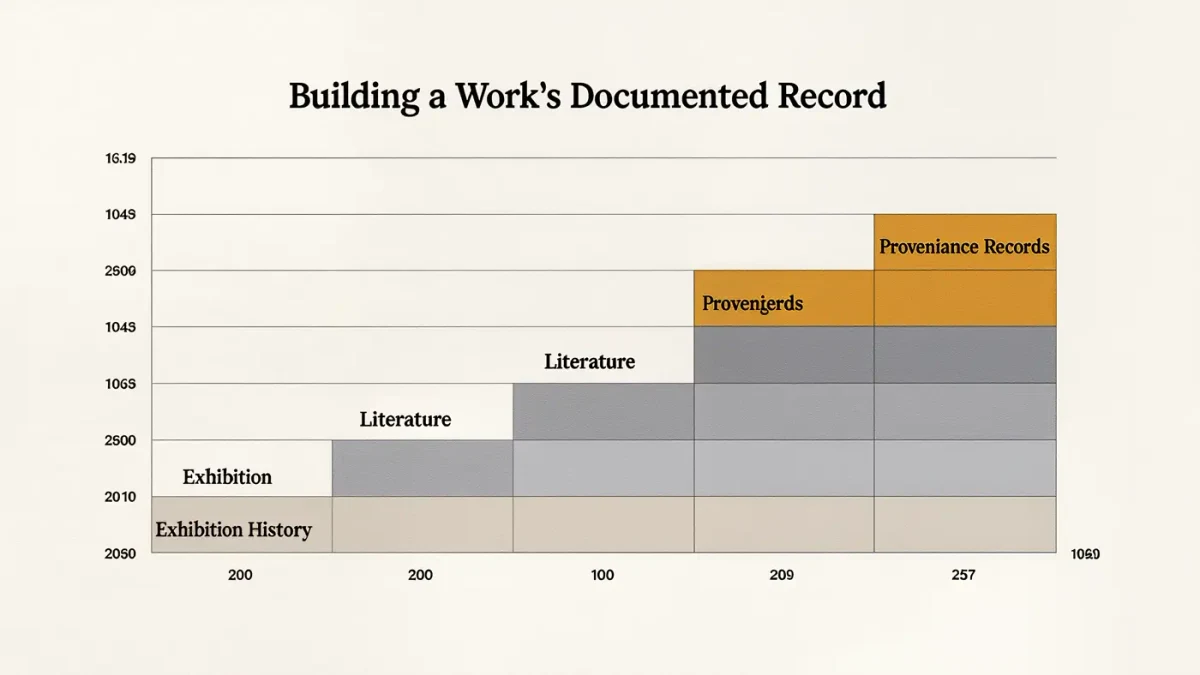
- Identification. Physical examination, measurements, signatures and inscriptions, condition, photographs — plus documentation: provenance, literature, exhibition history.
- Market research. Comparable results — auction records with and without fees, dealer asking prices, private sale intelligence — adjusted for condition, provenance quality, size, period and market timing.
- Reconciliation. The appraiser weighs the adjusted comparables and arrives at the concluded value, documenting the reasoning.
- Report and workfile. A signed report meeting USPAP content standards, with the underlying file retained for potential review.
Why Appraisals Exist: The Three Client Situations
Insurance. Schedules of insured value need periodic refresh because art values drift; a five-year-old insurance value on a market that has moved is either inadequate coverage or wasted premium. Tax. Charitable donations of art above modest thresholds require a qualified appraisal, and the IRS maintains art review panels that can challenge deduction values; estate valuation follows fair market value definitions with their own case-law texture. Transactions and disputes. Consignment decisions, marital dissolutions, collateral lending and warranty claims all call for a defensible third-party number. In each case the report's audience is not really the collector — it is whoever might later test the number.
Comparables: The Appraiser's Raw Material
Every value conclusion ultimately rests on comparables — the recorded outcomes for similar works — and the craft lies in the word similar. Auction records are the most accessible data, but they arrive distorted: they are with-fee totals that must be converted to hammer equivalents, skewed by guarantees, and drawn only from works that chose the public channel. Dealer asking prices are visible but aspirational, representing the top of a negotiation rather than its outcome. Private sale results — the largest volume of the market — are largely invisible, known only through the networks a working appraiser cultivates for exactly this reason. Adjustments then do the analytic work: condition differences, size (rarely linear in effect), period and subject desirability, provenance quality, exhibition and literature records, even the auction season in which a comp sold. A defensible appraisal shows this arithmetic transparently, which is the real content of the workfile USPAP requires. When two competent appraisers differ, they are usually weighting the same comparables differently — and the disagreement itself is information about how much uncertainty the object's market genuinely carries.
When to Get One, Concretely
The triggering events are quotable. A purchase above your insurance policy's per-object sublimit needs a scheduled valuation. A planned charitable donation needs a qualified appraisal before the deduction, not after. A death in the family of the collection's owner triggers estate valuation on the applicable date, with consequences that compound for executors who guess. A divorce, a loan secured against art, a gallery consignment decision, an insurance claim after damage — each requires a number of a specific type, prepared for a specific audience. The professional habit is simple: when a life event touches the collection, commission the paper before acting on the assets, because the appraisal that documents value at the right moment is worth multiples of its fee in the dispute that may follow, and no appraisal at all is the most expensive kind.
FAQ
What does an art appraisal cost?
Typically an hourly rate, a per-object fee or a project fee — never a percentage of value, which USPAP ethics treat as a disqualifying conflict. Cost varies with specialization, research depth and report requirements; tax-purpose reports with full documentation cost more than insurance refreshes.
How often should a collection be reappraised?
Insurance schedules are commonly refreshed every three to five years, sooner for artists in fast-moving markets. The general principle: reappraise when the market for the specific artists has demonstrably moved, not on the calendar alone.
Is an appraisal the same as an authentication?
No — they are different disciplines with occasional overlap. Appraisal establishes value assuming identification; authentication establishes whether the work is what it claims to be. Many appraisers will not value a work whose attribution they consider unresolved.
Will the IRS accept any appraisal for an art donation?
No. Above thresholds, deductions require an appraisal by a qualified appraiser meeting regulatory definitions, in a compliant report format, and the IRS's art review process can challenge values. Errors here are expensive, which is why tax-purpose appraisals are the most conservative work product in the field.
Can I appraise my own collection?
You can estimate, but a self-valuation is not an appraisal in any sense an insurer, court or tax authority will credit. The entire value of the document is independence — a qualified stranger's defensible opinion.