How do artist-run galleries survive without dealers? On dues and labor. A cooperative gallery is owned and operated by its artist-members, who pay monthly or annual fees, staff the desk, hang the shows and split costs — in exchange for guaranteed exhibition slots and full or near-full proceeds from sales. The model is old (New York's Phoenix Gallery and A.I.R. Gallery date to the 1950s and '70s co-op wave) and durable, because it solves the emerging artist's core problem: no representation, no venue, no market history — and it does so without a single outside investor.
What Is a Cooperative or Artist-Run Gallery?
Definitions vary by country and era, but the family resemblance holds. The co-op proper is member-owned: artists join by application or jury, pay dues (commonly $50 to $300 a month at U.S. co-ops, more in high-rent cities), and receive scheduled exhibitions plus a vote on programming. The artist-run centre — the Canadian term of art for a sector that has had federal funding since the 1970s — is typically incorporated as a nonprofit with a paid director and a board drawn from the artist community. The European association-style spaces run on memberships, project grants and volunteer enthusiasm. What unites them is the inversion of the commercial logic: the gallery exists to serve artists' development, not to extract a commission.
The trade-offs are equally structural. Guaranteed shows mean no market selection pressure — the co-op cannot tell you your work is unsellable, because you are the owner. Sales commissions are low (10 to 30 percent covers costs, versus 50 percent commercial) but absolute volume is too, since the co-op's collector network is thinner than any Chelsea roster's. The co-op is a career instrument, not a business.
How Does the Money Work?
The co-op budget is a study in small numbers done carefully:
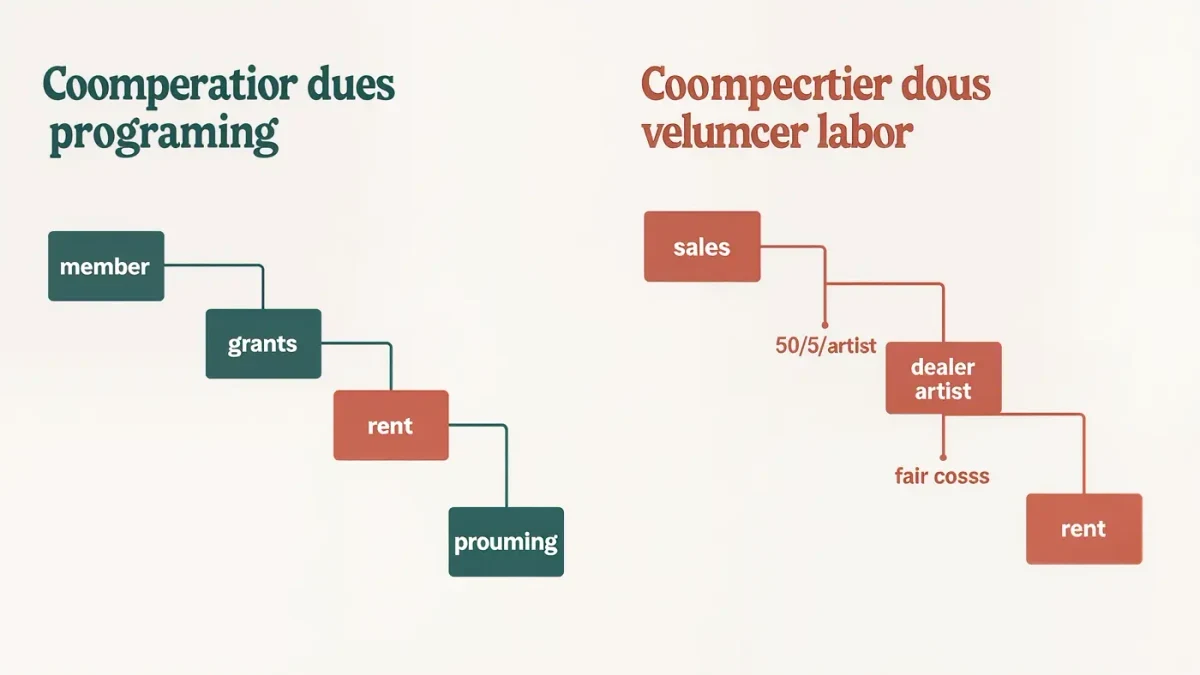
- Membership dues: the revenue base — a 40-member co-op at $150 a month yields $72,000 a year, enough for modest rent in most U.S. cities outside the coastal majors.
- Exhibition fees and commissions: non-member juried shows often charge entry fees; member sales pay a small commission back to the organization.
- Grants: state and municipal arts councils, community foundations and, in Canada, the artist-run centre funding system.
- Labor: members staff openings, sit the desk, build walls and clean — the invisible subsidy that makes the math work.
Rent is the existential line item, and co-op history is largely real-estate history: the famous waves — 1950s New York, 1970s SoHo and Tribeca, 1990s Brooklyn and Berlin — all began with cheap floorspace and ended when the neighborhood's rents caught up with the artists who made it interesting.
Juried Memberships and How Admission Works?
A credible co-op juries its admissions, because every member's reputation hangs partly on the roster's overall level. The process mirrors institutional gatekeeping in miniature: portfolio submission, committee review, sometimes a studio visit, periodic membership reviews to prune inactivity. The best co-ops are genuinely selective and function as peer academies; the worst drift into pay-to-show vending, which is the reputation risk every applicant should assess before writing the dues check. The question worth asking a co-op's director is blunt: what percentage of current members would you re-jury today?
Why Do Artists Join Instead of Waiting for a Gallery?
Because waiting is not a strategy. A co-op supplies the two things an unrepresented artist cannot buy on any market: a professional exhibition record with dates, venues and catalogue documentation — the raw material of a CV that museums and commercial galleries actually read — and a peer network that functions as information infrastructure (which curator is looking, which residency pays, which dealer is honest). The historical track record is the selling point: artist-run spaces have repeatedly served as the sector's research-and-development layer, from the 1960s alternative-space movement through the artist-run centres that incubated generations of Canadian art. Commercial galleries rarely scout the co-op wall directly, but they scout the artists whose CVs got long enough there to be visible.
The institutional ladder typically runs: co-op or artist-run space first, then the nonprofit artist-project space or university gallery, then the young commercial gallery, then the fair program. Each rung adds market validation the previous one cannot confer. Skipping rungs happens — every so often a museum acquires straight out of a membership show — but the ladder is the norm because it is the only chain of trust the sector's gatekeepers share.
The lineage matters because the sector keeps proving the point. The 1970s alternative-space generation in the United States — the artist-founded venues that took over empty industrial floors when landlords had no better tenants — produced a disproportionate share of the artists who defined the following decades. Berlin's artist-run project spaces of the 1990s and 2000s did the same for a generation now firmly in museum collections. The pattern is consistent enough to be structural: where rent is cheap and artists organize, the market's next decade is being rehearsed, usually for free.
Rent is therefore the true program director. A co-op's curatorial identity, membership size and even exhibition calendar are downstream of the lease; when the lease breaks, so does the institution. This is why the longest-lived organizations treat real estate as their primary strategic question — buying when possible, partnering with universities or municipalities when not — and why every co-op boom in art history maps neatly onto a property crash that preceded it.
What Are the Known Failure Modes?
Three, and they are chronic. Volunteer burnout: the members doing the labor eventually get careers, or jobs, or tired, and the space folds the moment its two hardest workers quit. Mission drift toward vanity exhibition: when dues matter more than juries, quality collapses and the co-op becomes a rental hall with better lighting. And capital fragility: with no reserves, a single rent reassessment or grant rejection ends the organization. The survivors — and decades-long survivors exist on every continent — institutionalize deliberately: bylaws, paid part-time staff, grant pipelines and, where possible, owned real estate.
| Co-op gallery | Commercial gallery | |
|---|---|---|
| Ownership | Artist-members | Dealer |
| Selection | Juried membership; scheduled shows | Dealer's roster; market-driven |
| Commission on sales | 10–30% | ~50% |
| Revenue base | Dues, grants, fees | Sales, fairs, secondary dealing |
| Career function | CV-building, peer network | Market construction, placement |
FAQ
What is the difference between a co-op gallery and a commercial gallery?
A co-op is owned and run by its artist-members, who pay dues and staff the space in exchange for exhibition slots and sales commissions of 10–30 percent. A commercial gallery is dealer-owned, selects artists for market potential, takes roughly 50 percent — and provides no guaranteed shows to anyone.
Are cooperative galleries pay-to-show scams?
Legitimate co-ops charge dues but jury their admissions and cap membership; the fees fund shared infrastructure, not a dealer's profit. The scam version is the vanity gallery renting wall space to anyone — the test is selectivity and what the space's exhibition history looks like.
Can a co-op show lead to gallery representation?
Indirectly but routinely. Co-op exhibitions build the documented CV, press and peer network that make an artist legible to young commercial galleries and curators — representation follows the record, and the record has to start somewhere.
Do artist-run spaces receive government funding?
Many do: Canadian artist-run centres have had a dedicated federal funding framework since the 1970s, while U.S. and European spaces draw on municipal and state arts councils, community foundations and project grants — with membership dues still carrying most of the rent.