What is an art review actually judging? Not whether the critic liked the show — a review is an argument, not a verdict emoji. Working criticism evaluates an exhibition against a surprisingly stable set of criteria: the coherence of the curatorial thesis, the quality and condition of the works, the intelligence of the installation, the show's contribution to how we understand the artist or the moment, and whether the whole enterprise justified the square footage. Understanding those criteria makes reviews more useful to collectors, since critical reception is one of the slow variables that hardens into market value.
What Is the Review Actually Evaluating?
The first move of any serious review is deciding what the exhibition is claiming to be. A museum retrospective of a canonical figure makes one kind of claim — here is the whole career, reinterpreted — while a first commercial solo show makes another, humbler one. The critic's central question is whether the show's ambition matched its execution. A modest exhibition beautifully realized earns more respect than a grand one that collapses under its own thesis, which is why reviews of blockbusters so often read as disappointed: the bigger the claim, the more ways to fail it.
This is also why the same exhibition can receive opposite reviews. One critic treats a show as history (did it change what we know?), another as experience (did it change what we feel?), a third as industry (what does it do for the institution's brand?). All three are legitimate criteria; they are simply different tests applied to the same object.
The Criteria, One by One
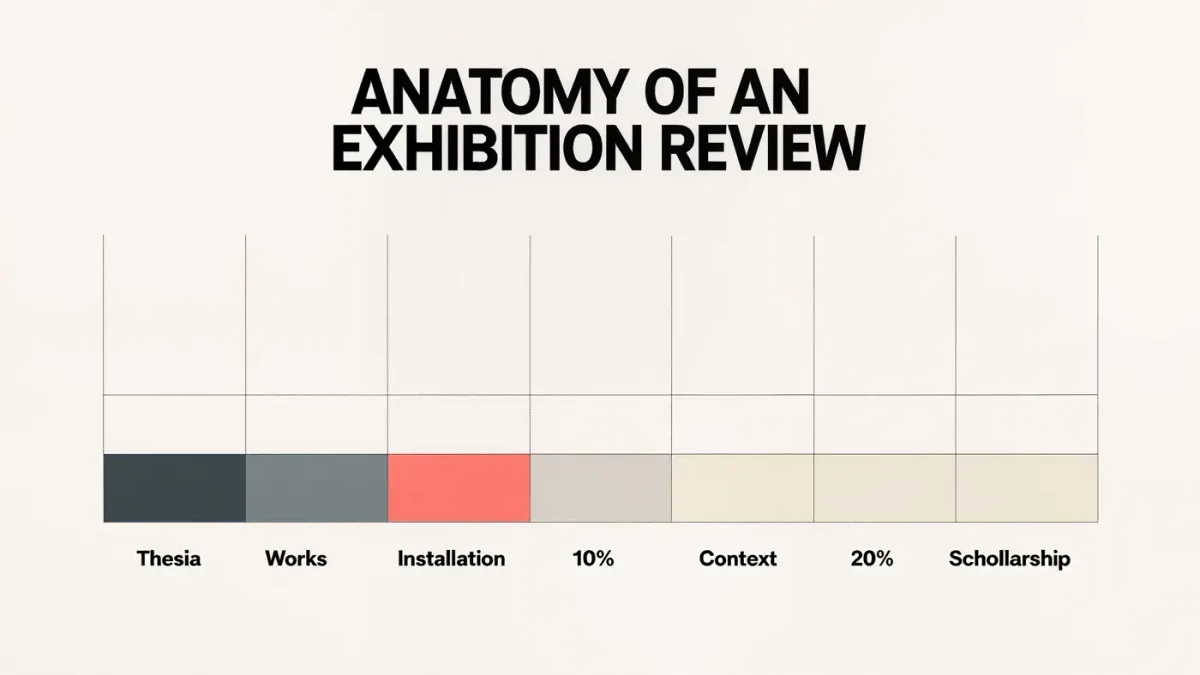
Thesis and coherence
Every exhibition proposes an argument — a wall text, a selection, a sequence. The critic asks whether the argument is original, whether the works actually support it, and whether the sequencing advances it or merely decorates it. Incoherent group shows get savaged on this count more than any other: a weak thesis turns thirty good artists into a bad exhibition.
The works themselves
Quality of loans, condition, range. A retrospective that concentrates on the famous late period at the expense of the formative early work gets flagged as banking on hits; a survey that includes the failures alongside the triumphs earns trust, because the curator treated the artist as a history rather than a brand. Condition matters more than civilian readers expect — a great painting exhausted by over-cleaning or an installation surviving only in partial form changes what can be judged at all.
Installation and sequitur
Wall heights, sightlines, lighting, pacing, label prose. Critics describe these in detail because installation is interpretation: hanging the late black paintings in a narrow corridor says something different than giving them a cathedral bay. The best installation criticism explains what the physical experience of the show was engineered to make the visitor conclude.
Context and contribution
Has this artist been shown this way before? Does the show revise a consensus, rescue a neglected figure, or retell a story everyone knows with more expensive loans? Novelty of contribution — not novelty of art — is the criterion. This is where institutional politics enters quietly: a critic who knows that a rival museum staged the definitive version fifteen years ago will measure the new one against it.
The catalogue and scholarship
For museum shows, the catalogue is part of the work under review. New research, archival discoveries, a genuinely reconsidered chronology — critics weigh these because they outlive the installation and, incidentally, because they feed the artist's long-term market documentation.
How to Read a Review Critically
- Identify the criteria being applied. Is the review judging the works, the thesis, the installation or the institution? Reviews that never say are reviews that never decided.
- Separate description from evaluation. The descriptive passages are the critic's evidence; the evaluative ones are the argument. If the evaluation does not follow from the description, the review is decoration.
- Check the comparisons. Critics locate a show against predecessors and peers. Those reference points tell you more about the verdict than any adjective — praised against weak comparators, the compliment is diluted.
- Watch for the buried lede. The most consequential fact in a review — a dating revision, an attribution question, a political controversy — often appears in a subordinate clause, not the headline.
Why This Matters Beyond the Sunday Supplement
Critical reception is a lagging but stubborn input into market value. Reviews do not move auction results; they move museum acquisition committees, which move retrospectives, which move markets — a transmission chain measured in years. For a living artist, a serious review in a national outlet is documentation; for a mid-career artist whose first museum survey receives strong notices, those clippings become part of the exhibition history that appraisers and specialists later cite. The smart collector reads criticism not for verdicts but for the descriptive evidence inside it: what was shown, in what condition, hung how, said to be important why. That is primary research, available for the price of a subscription.
The Genre's Known Failure Modes
Criticism has recognizable vices, and knowing them sharpens reading. The shopping review evaluates the market positioning of the artist rather than the exhibition — who represents them, what they fetched at auction, which collection lent the work — art coverage as finance with adjectives. The thesis-parade review performs the curator's argument rather than testing it, reproducing wall-text language in place of looking. The colleague review, written by a critic with friendships, rivalries or institutional entanglements in play, explains an otherwise puzzling generosity or severity. And the event review covers the opening, the crowd and the politics while the work itself goes undescribed — the tell being that a reader finishes without knowing what was in the rooms. None of these modes is disqualifying on its own; reviews are written by humans with beats and histories. But a reader who can name the mode can extract the usable evidence from any review, including a bad one, which is a more useful skill than agreeing with the verdict.
FAQ
Do art critics follow a shared set of standards?
There is no checklist, but a stable family of criteria recurs: coherence of thesis, quality and condition of works, intelligence of installation, novelty of scholarly contribution and fit between ambition and execution. Individual critics weight these differently, which is why the same show earns opposing reviews.
Can a review of an exhibition differ from a judgment of the artist?
Yes, and good critics say so explicitly. A mediocre show of a major artist and a brilliant show of a minor one are both common. The unit of judgment is the exhibition as an argument, not the artist's overall standing — conflating the two is the classic error of promotional coverage.
Why do some reviews spend so much time on wall colors and lighting?
Because installation is interpretation. Sequence, sightlines and lighting embody the curator's argument physically; a review that ignores them is judging a checklist of loans rather than an exhibition.
Does critical reception affect art prices?
Indirectly but durably. Strong reviews influence museum acquisitions and future exhibitions, which feed the exhibition history and documentation that markets price over years. Reviews rarely move prices directly; they move the institutions that do.
What makes a review worth reading for a collector?
The descriptive evidence: what was exhibited, in what condition, with what new scholarship and comparisons. Verdicts are disposable; accurately reported specifics become part of an artist's documented record.