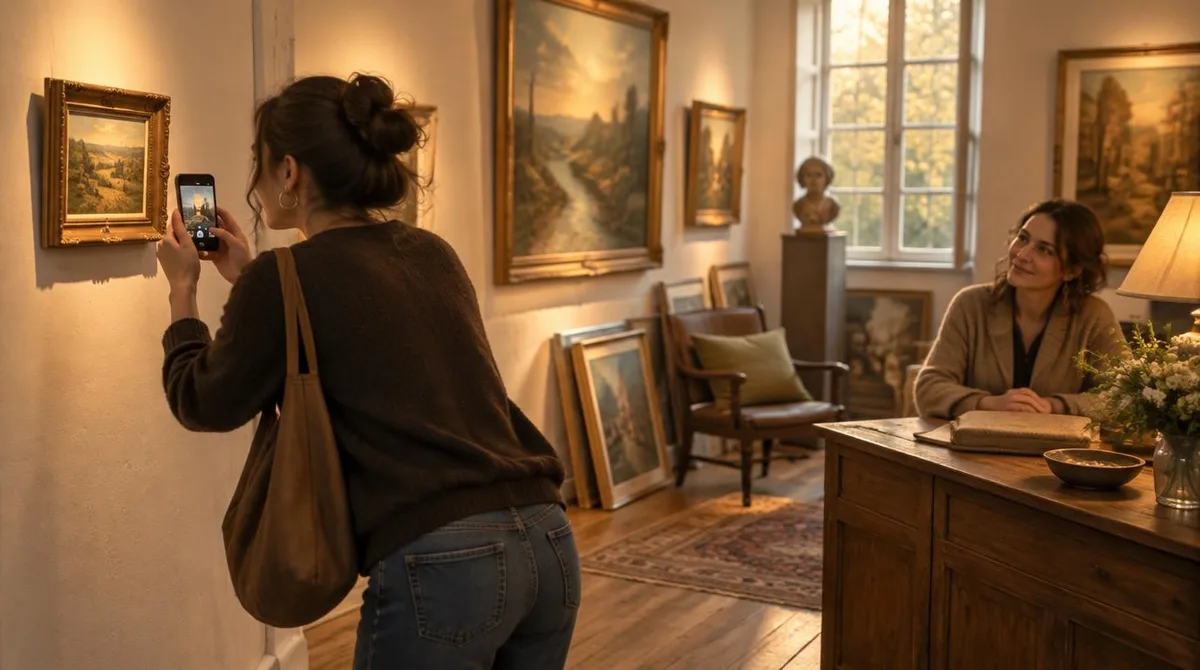
You can walk into almost any commercial art gallery without buying anything, without an appointment, and without knowing a single artist's name. You can look, ask questions, take photos in most cases, and walk out empty-handed with nobody offended. The main qualification: a gallery is a small business, not a museum, so the staff are watching sales as well as visitors — but watching you is not the same as judging you.
The fear is misplaced. Dealers want foot traffic, and the person who comes in to look on a Tuesday is the person who comes back to buy on a Saturday. What follows is a plain answer to each of the rules people worry about: photos, questions, touching, staying too long, and whether silence at the exit costs anyone anything. For related coverage, see Art Fair Economics: What a Booth Really Costs, Whether Galleries Profit, and Why They Keep Going Back. This connects to our earlier piece, Art Fair Economics: What a Booth Really Costs, Whether Galleries Profit, and Why They Keep Going Back.
Can you take photos in a gallery?
Usually yes, and most dealers are quietly pleased when you do. A photo shared with friends is free marketing, and galleries live on word of mouth. Two limits apply. First, ask if a show includes work on loan from a private collection or another estate; some lenders restrict photography, and the desk will tell you in one sentence. Second, never use flash — it fades pigments and dyes over time, the same reason museums ban it.
If a gallery does say no, take the answer at face value. It is about the lender's contract or the fragility of the materials, not about you.
Do you have to be quiet, and can you ask questions?
Ask everything. Price, medium, why the hang looks the way it does, who the artist studied with — the desk answers these all day, and a good dealer considers the conversation part of the job. The only question that lands badly is the one asked as a challenge: "Why is this worth that?" The same question, asked as curiosity — "What drives the price here?" — gets a real answer, often a useful one about the artist's exhibition history or how prices on the primary market get set.
Voice level is ordinary conversation level. This is a shop, not a church. What staff do mind is a phone call taken at full volume three feet from a painting someone else is studying.
Can you touch the art or the frames?
No — and the rule is stricter than most visitors realize, because the danger is not the front of the canvas. Fingers carry oils that etch into varnish, and a bump to a frame can crack gesso or knock a stretcher bar out of square. Anyone who has stood behind a canvas knows how little separates a painting from disaster: a thin wooden bar, a few staples, sometimes a backing board that has warped. Keep hands in pockets in small rooms, and give pedestals extra distance — a sculpture tipped by a backpack strap is a loss nobody can undo.
The two-meter rule from museums is a museum rule, not a gallery law. In a small showroom the work may hang closer than that by necessity. The real rule is simple: nothing you carry or wear touches anything on the wall.
Do you have to buy something?
You do not. This is the myth worth killing outright. Dealers price work knowing that most visitors will never buy, and they budget for it — rent, insurance, and the artist's share all get built into the price of the pieces that do sell. A visitor who looks carefully, asks the artist's name, and signs the mailing list has given the gallery something real: a future collector in the pipeline.
What actually annoys dealers is not the non-buyer. It is the visitor who uses the showroom as a free consultation, gets a condition report or a valuation conversation, and then buys the work elsewhere. Browsing honestly costs a gallery nothing. Siphoning expertise does.
What this means for your first visit, step by step
Our analysis of how visits actually go wrong comes down to a handful of habits, none of them complicated:
- Enter, and let the desk greet you. A nod and "just looking" is a complete sentence, and nobody will follow you around.
- Read the price list if one sits at the desk; many galleries post it precisely so nobody has to ask.
- Look at labels for medium and dimensions before deciding what you think — a 20-centimeter print and a two-meter canvas earn different reactions in person.
- Ask one question you actually want answered. Price is fine.
- If you like the show, say so on the way out. It costs nothing and the desk remembers it.
The bare-walled showroom style trips people up here. The white cube look — white walls, no furniture, no visible staff — was designed to strip away distraction, but it reads to newcomers as a room where talking is forbidden. It is not. The room is bare so the art carries the room, not so the visitors hold their breath. This connects to our earlier piece, How Commercial Art Galleries Work: The 50/50 Split, Consignment, and the Real Cost of a White Cube. For related coverage, see How Commercial Art Galleries Work: The 50/50 Split, Consignment, and the Real Cost of a White Cube.
Does gallery etiquette change by gallery type?
It loosens as the business model gets less rarefied. Cooperative galleries, where artists pay dues and staff the desk themselves, are the friendliest rooms in the trade — the person greeting you may be the person who made the work on the wall. The South Carolina gallery guide published by Art-Collecting.com lists, for example, a 17-member artist cooperative in Pendleton whose members live and work in the state, selling everything from oil paintings to woodturned bowls — the kind of place where asking about process gets a studio answer, not a sales script.
Regional gallery scenes run the same way. According to the Charleston Gallery Association's galleries page, the association enumerates 37 member galleries, from the Charleston Artist Guild Gallery to specialist showrooms, and most operate on a walk-in basis during business hours. City gallery districts, in Charleston or anywhere, are built for exactly the kind of casual crawl that etiquette anxiety talks people out of. In the biggest blue-chip spaces, the etiquette barely changes — you still walk in, still look, still may not touch — only the price list is kept closer to the desk.
Openings are the one event with different rules: they are part party, and the crowd is there to see people as much as pictures. The rest of the week, the showroom belongs to whoever walks in.
The one rule that actually matters
Treat the gallery as a working business run by people who like the art, and nearly every etiquette question answers itself. Look hard, touch nothing, ask what you want to know, and leave when you are done. If a work follows you home in your head for a week, go back and ask about the price — that is how most collections start, and dealers know it.