A gallery press release is a sales document dressed as news. Its job is not to inform but to position: to make a show sound inevitable, an artist sound established, and a price sound reasonable before anyone has seen the work. Learning how to read a gallery press release means learning to translate its inflated language back into the plain facts underneath—what is being shown, by whom, and what the gallery hopes will happen.
The translation skill matters because the genre has rules. Press releases rarely lie outright; they inflate, omit, and rearrange emphasis. An editor reads for what is missing as much as for what is stated. The word "read" itself, as Merriam-Webster defines it, includes interpreting significance from outward signs—reading a person "like a book," anticipating what comes next from observed behavior. That is precisely the operation a press release demands: the text is written to produce an impression, and the careful reader's task is to reverse-engineer it.
What is a gallery press release actually for?
A press release is a pitch aimed at three audiences at once: journalists, collectors, and the artist's own career file. The gallery wants coverage, but coverage is secondary. The primary function is to supply collectors with a story they can repeat when they hang the work, and to supply the artist with a line—"solo debut," "museum-adjacent," "first New York showing"—that will appear in future announcements and, eventually, in the artist's CV. Every phrase is written to be lifted. That is why the language is so polished and so empty at the same time: it is designed for quotation, not for argument.
This is also why press releases follow a near-universal template. The artist's name and the show title come first. Then a paragraph of positioning. Then a compressed biography. Then logistics—dates, address, hours—buried at the bottom like a receipt. The order itself is information: the gallery is telling you that the narrative matters more than the visit.
Which words should raise an editor's eyebrow?
Certain terms appear in nearly every release and nearly always mean something narrower than they sound. A short decoder:
- "Investigates" — the artist is trying something new and it may not have fully worked. "Investigates themes of memory" means: the work is about memory, possibly vaguely.
- "Recontextualizes" — old material, new arrangement. Sometimes genuinely interesting; sometimes a frame around work that would not hold attention on its own.
- "The body" — expect figurative work, likely with visible brushwork or texture. The phrase is a genre marker, not a claim.
- "Timely" or "urgent" — the subject is in the news. This is a sales argument dressed as critical judgment: buy now because the moment is now.
- "Critically acclaimed" — unattributed and therefore nearly meaningless. An editor immediately asks: which critics, where, and when?
- "Seminal," "iconic," "visionary" — pure inflation. Delete these mentally and see what survives.
Wall text jargon and press-release jargon share a dialect. Both are written to sound like scholarship while performing persuasion. The honest version of "the artist subverts the tropes of the pastoral tradition" is usually "the artist paints fields, with a twist."
How do you spot what the release is not saying?
Omission is the genre's sharpest tool. The three omissions worth checking first:
- Price. Primary-market releases almost never state one. Silence here is normal—the gallery sets prices privately, often tiered by collector priority—but a reader should understand that the absence is commercial, not aesthetic. (How a number travels from studio to gallery is its own process, covered in our piece on primary-market pricing.)
- Representation status. If an artist is not named as "represented by" the gallery, the show may be a one-off, a loan from another dealer, or an audition on both sides. That distinction changes how the market will treat the work afterward.
- Provenance of the works shown. If a "new work" section sits alongside pieces dated years earlier, the gallery may be moving older inventory under the cover of a fresh show—worth knowing before anyone calls it a debut.
Another tell: the biography's structure. A CV paragraph that leads with a museum group show from a decade ago and skips recent activity is doing damage control. Chronology is content. Read the dates, not just the institutions.
What does the artist's biography actually tell you?
Biographical paragraphs in press releases are compressed career arguments. The order of listed achievements signals what the gallery considers the artist's strongest credential, and the credentials themselves decode into market stages. "Work held in private collections" means sales, unverified. "Included in the collection of [museum]" means a museum owns at least one piece—sometimes a gift from the artist, sometimes a purchase, sometimes a trustee's donation; the release will not say which, and the difference matters. "Recipient of [grant]" signals institutional respect and, often, that the artist can afford to keep working without selling everything.
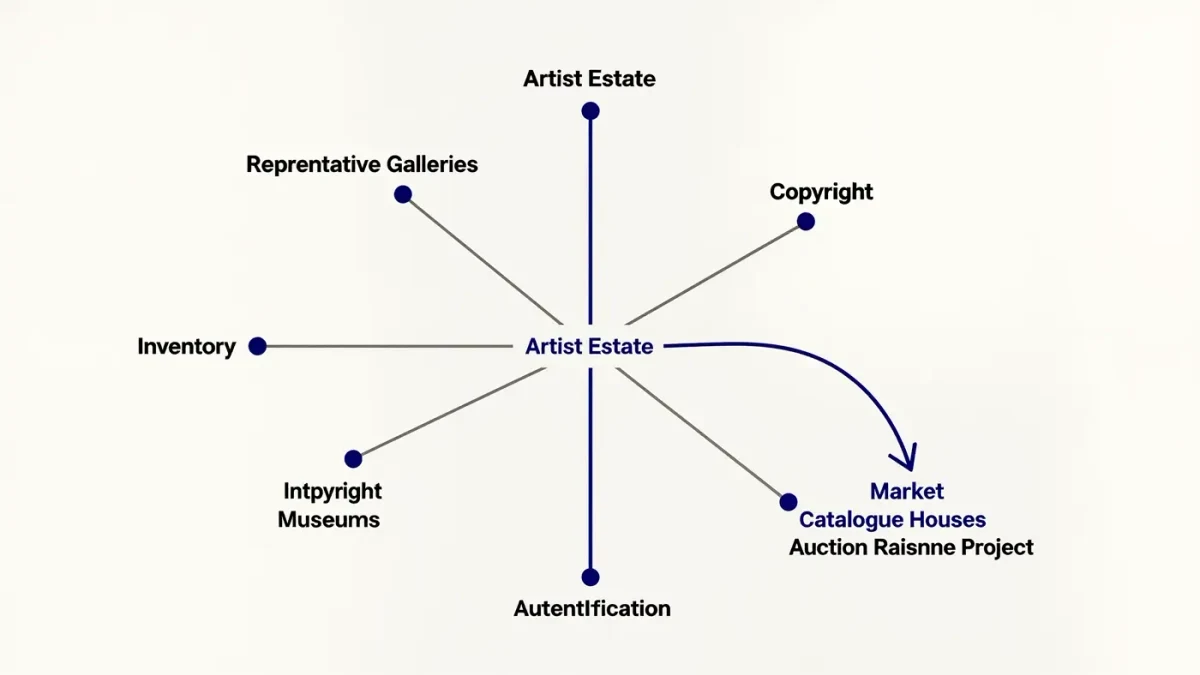
Watch, too, for what happens when a gallery represents an estate. Releases about dead artists lean on historical framing—"rediscovery," "long-overdue reassessment"—because the sales pitch is different: the work is finite, and scarcity is the argument. Our coverage of artist estates and their galleries unpacks who controls that narrative and why it matters. For related coverage, see Artist Estates and Their Galleries: Who Represents the Dead and Controls the Market Afterward.
How should a collector use a press release?
Use it as a map, not a verdict. The release tells you what the gallery wants you to think; the visit tells you whether the work supports the claim. A practical sequence:
- Read the release once, fast, and note the central claim—the one sentence the gallery would most like quoted.
- Strip the adjectives. What remains are the checkable facts: medium, scale, dates, institutions, prior shows.
- Verify the checkable facts against the artist's CV or the institutions' own listings. Anything unverifiable should lower your confidence in the rest.
- Then look at the work and ask the blunt question the release was built to pre-empt: does it hold up at the distance the gallery's prose implies?
Collectors who skip the translation step tend to buy the story. Collectors who do it tend to buy the work. Galleries, to be fair, are small businesses with rent and staff, and the press release is one of their cheapest marketing instruments—a flyer with better manners. Reading it skeptically is not hostility toward the gallery; it is the literacy the format assumes. This connects to our earlier piece, Who Sets Prices on the Primary Art Market? How a Number Travels From Studio to Gallery to Fair.
Our analysis: the release as a genre worth studying
The gallery press release persists because it works on everyone a little. Even editors who decode it professionally absorb its emphasis—which artist the gallery is pushing, which show will get the bigger budget, which language signals ambition. That is useful intelligence. The genre tells you where the money is pointed before the market shows it, and for anyone following the trade—collectors, writers, artists pricing their own careers—that forward signal is the release's real content. The inflated language is noise; the emphasis is the message.
What remains unknown in any single release is everything the gallery chose not to print: the price, the collector list, the artist's actual standing with the dealer. Those answers live elsewhere—in the gallery's behavior over time, in the fair calendar, in who shows up at the preview. The press release is the opening statement. Treat it accordingly.