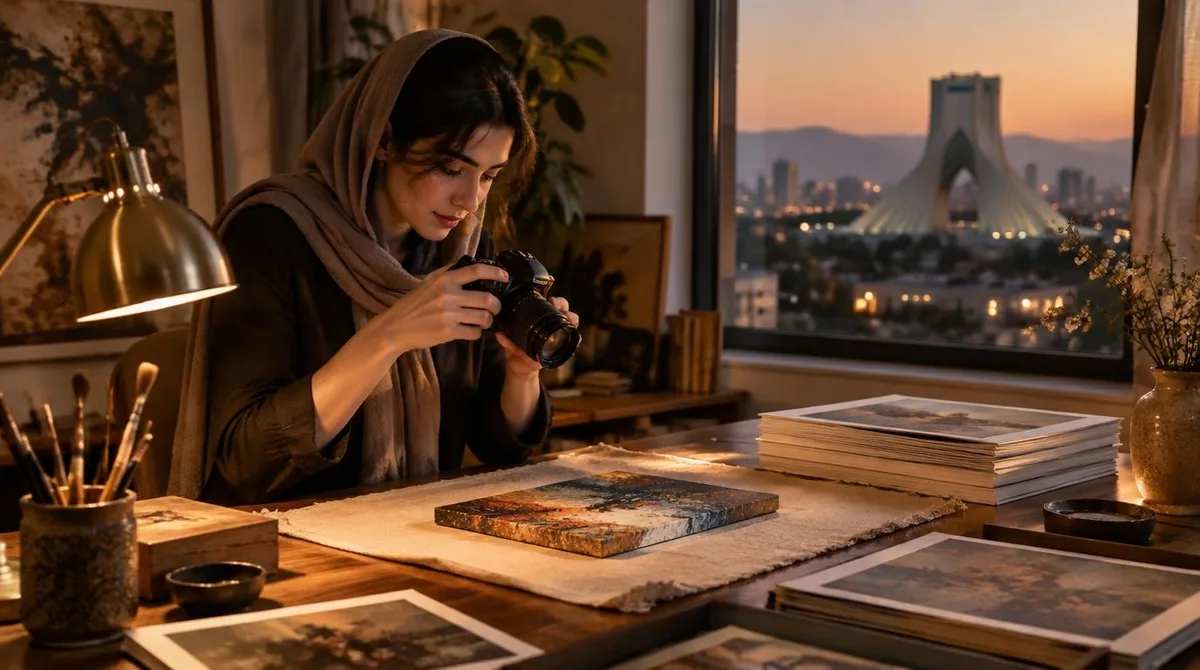
Inside Iran, contemporary artists now reach the global art world through a single nonprofit platform. Since August, "Continuum: Artist Relief for Iran" has offered more than 500 original works by over 200 artists living and working across Iran for sale online, with participating galleries waiving their commissions so that 100 percent of proceeds go directly to the artists, according to Observer. It is, by its organizers' count, the largest online exhibition in the history of contemporary art in the country.
The project matters beyond Iran because it answers a question every curator eventually faces: what can be done when the structures that sustain artistic practice suddenly disappear? Sanctions and a year of geopolitical conflict have left Iran's art scene struggling to obtain materials and, in many cases, the means to live. Continuum's answer was to build a bridge online, and the mechanics of that bridge are worth studying by anyone who cares about how artists survive a crisis.
The initiative is run by two curators. Dario Duran, founder of galleries-adjacent venture Duran Art Projects, was born in Shiraz and left Iran at age five, growing up in Canada. Mariam Rasti, an Iranian independent curator, has spent more than a decade directing artistic projects in Iran and working closely with emerging and early-career artists. Together they assembled a selection of mostly new work spanning painting, drawing, photography, sculpture, installation, mixed media and interdisciplinary practices.
Why do Iranian artists need an initiative like this at all?
It has never been easy for Iranian artists to circulate their work internationally unless they live abroad. The past year's conflict and the sanctions that remain in effect have made it harder still. According to Observer, exhibitions have been canceled or postponed, galleries are not operating normally, and artists are losing opportunities and income.
Digital connection is fragile too. Duran reports that rather than being shut down entirely, connections inside Iran have been intermittently throttled, making VPNs unreliable and often blocking filtered applications such as Instagram and WhatsApp. Conditions change from one day to the next, which makes communicating with the rest of the world a constant challenge. For an artist whose market depends on visibility—studio visits, fair appearances, Instagram DMs to collectors—throttled internet is not an inconvenience. It is a closed door.
How did the project actually get built?
The origin story is instructive for anyone planning cultural relief work. The idea began modestly: a PDF featuring some 30 artists in urgent financial need, to circulate among Duran's international network of gallerists, curators, museum directors and collectors. Duran wrote an open letter and sent it through WhatsApp despite poor internet access. Colleagues abroad responded with offers of help.
"Every single one of them got back to me. Some cried and said, 'What can we do? We will do anything that we can to help,'" Duran told Observer. "I realized the scale of this could become much larger."
Over roughly six months, the PDF concept grew into a fully curated online exhibition. The curators spent months on research and outreach. The scale jumped from 30 artists to more than 200. That trajectory—from emergency list to platform—is the durable lesson here: relief work scales when the initial ask is small enough that people can say yes immediately.
Who is behind Duran Art Projects?
Duran's path explains the project's credibility inside and outside Iran. After studying photography and completing a master's in curatorial studies, he worked in fashion and art in Europe, focused mostly on Western contemporary art. "I always joke and say the only Iranian artist I knew before moving to Iran was Shirin Neshat, and that was it," he told Observer.
Roughly six years ago he moved back to Iran, expecting to stay a year. He stayed, collecting contemporary Iranian art and advising artists on how to break into the international market. About a year and a half ago he established Duran Art Projects in Canada as a platform devoted to contemporary Iranian art. Continuum is its first major curatorial endeavor, and it emerged during the war, when Duran and Rasti were both displaced from their respective cities and speaking constantly with artists, galleries and communities across the country.
What can collectors and institutions actually do with it?
Continuum functions as more than a sales site. The curators hoped the platform would open a broader dialogue with the international art community and give emerging artists in Iran visibility they would otherwise struggle to obtain. That visibility, Duran says, is producing results: museum directors, major collectors with internationally known collections, curators and gallerists have reached out. We covered a connected angle in Museum Trustees Explained: Give/Get, Conflicts of Interest and Who Really Runs the Museum.
For collectors, the practical point is straightforward. The works are available for sale online, prices go entirely to the artists, and the selection includes both emerging and established names. For institutions, the platform operates as a discovery tool—a way to survey the full range of contemporary practice in Iran without travel. The works themselves include pieces such as Najme Kazazi's Untitled (2025) and Ali Ganjavi's Untitled (2025), both presented by Duran Art Projects.
What does the model teach the wider art world?
Three things stand out. First, waiving gallery commissions was voluntary, which means the model depends on dealers accepting zero margin during a crisis—a structural choice, not a market one. Second, the platform treats sales and visibility as joint goals; the curators explicitly decided it could not be just about sales. Third, the whole thing was built on infrastructure that barely works. The team communicated with the outside world through brief windows of decent data speed.
Many have described the result as an "Iranian Artsy": a platform and collaborative network offering curators, institutions and collectors an unprecedented view of contemporary artistic practice in Iran today. Duran puts it more plainly. "What we've done through this initiative is really unprecedented. Iran, as a country and its contemporary art scene, has never had a program like this," he told Observer. For related coverage, see Museum Endowments Explained: The 5 Percent Rule and How Institutions Really Live.
What remains unknown is whether the model outlasts the emergency. The evidence so far covers the first few months of response and the outreach from institutions abroad. Whether those conversations turn into exhibitions, acquisitions and long-term gallery relationships for the artists involved is the next development to watch—and the measure of whether Continuum becomes a template or a one-off.