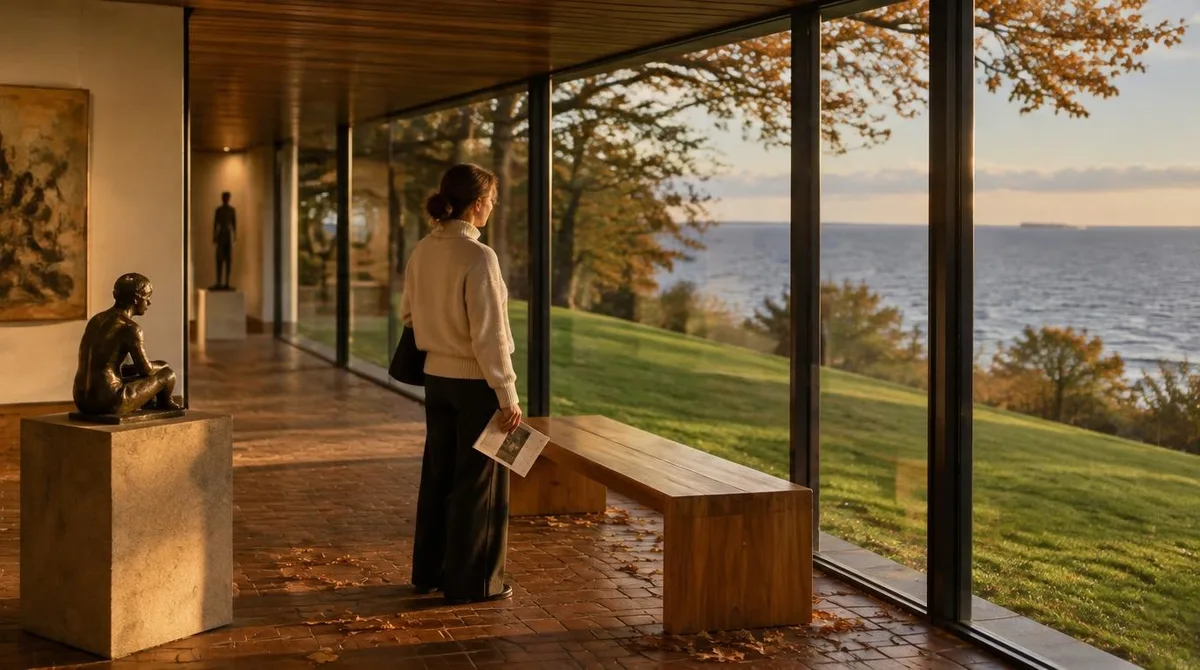
The Louisiana Museum of Modern Art is a modern art museum on the Danish coast north of Copenhagen, known for putting contemporary painting and sculpture in low-slung galleries that open directly onto lawns, water and sky. It is one of the most-visited art museums in Scandinavia, and it is the rare institution where the walk between rooms competes with the art itself. The qualification matters: this is not a box in a city center. It is a landscape you move through.
That layout is the whole point. The museum spreads across a sloping seaside property, with glass corridors and garden passages linking its wings, so a visit alternates between looking at art and looking at the Øresund. For travelers based in Copenhagen, it works as a half-day or full-day trip, and the practical details—getting there, what the collection holds, how the temporary program works—decide whether the outing sings or sags.
What is the Louisiana Museum of Modern Art?
It is a private-founded, public-facing modern art museum that grew by accretion rather than by grand plan. Instead of one monumental building, it is a chain of modest pavilions threaded through parkland and along the water's edge, each addition responding to the slope of the land and the view. Visitors move outdoors between galleries as often as they move indoors, which changes how the art is seen: a room of paintings reads differently when you have just crossed a lawn in open air.
The name confuses first-time visitors. It has nothing to do with the American state. The property reportedly took its name from an earlier owner, and the museum kept it—a reminder that many beloved European institutions began as private houses and gardens before they became museums. That pattern, a collector's home ground turning into a public treasure, recurs all over the world, from Frida Kahlo's Casa Azul to Monet's Giverny, as Art Report has covered in Artist House Museums Turn Private Homes Into Public Treasures: Casa Azul to Giverny. For related coverage, see Artist House Museums Turn Private Homes Into Public Treasures: Casa Azul to Giverny.
What distinguishes Louisiana from most house-turned-museum stories is scale and ambition. The collection and exhibition program are international in scope, and the museum has long treated modern and contemporary art as a single continuing story rather than a series of compartments. Expect the classic names of modernism alongside living artists, in rotating displays rather than a fixed, encyclopedic hang.
Why does the architecture get so much attention?
Because the buildings refuse to compete with either the art or the view, and managing that double demand is genuinely hard. Gallery ceilings are kept low and human-scaled. Corridors are glazed, so the sea appears and disappears as you walk. Walls are generous, floors are honest materials, and the transitions between inside and outside are handled with sliding glass rather than heavy doors. The effect is that the architecture disappears at the moments it should.
Anyone who has hung a show knows the problem: a dramatic building swallows quiet work, and a neutral box ignores its setting. Louisiana's answer was to let the landscape do the drama. The park, with its sculptural pieces set on the slope and the water beyond, functions as an outdoor gallery in its own right, and the buildings act as connective tissue. It is a lesson in restraint that many newer museums, built with bolder budgets, have failed to learn.
There is also a craft detail worth slowing down for, the kind a visitor misses on a first fast pass. The junctions—where a gallery meets a glass corridor, where a threshold meets a garden—are handled with the care of good joinery. Look at how the frames meet, how the floor levels change, how a doorway crops the horizon. The museum rewards a second, slower walk more than most.
What will you actually see there?
Two things, and they work together: a permanent collection of modern and contemporary art, and a program of temporary exhibitions that changes through the year. The permanent displays rotate, so the specific works on view on any given visit are not guaranteed—check the museum's own website before traveling if a particular artist or period is the reason for your trip. The temporary program is where the museum makes its international reputation, and major shows can reshape the whole visit, drawing crowds and reshuffling which galleries are busy at which hours.
Because exhibitions change, plan around what is on rather than around a fixed checklist. A sensible rhythm is one fast circuit to take in the whole property and its strongest rooms, then one slow pass through the two or three galleries that hold you. The sculpture park deserves its own hour, especially in good weather; the works are placed to be discovered along the paths, not lined up in ranks.
Part of the museum's appeal is simply that it takes looking seriously. Visitors who want a method rather than a checklist can use the approach in How to Look at Art: A Beginner's Method for Any Museum—it works as well on a Danish cliffside as in a city block. And the broader mechanics of how such a collection is built, from purchase to bequest, are covered in How Museums Actually Acquire Art: Purchase, Gift, Bequest, and the Rules on Selling.
How do you plan a day trip from Copenhagen?
Keep it simple and check the live details yourself, because hours, exhibition schedules and transport timetables all change. The museum sits on the coast north of Copenhagen, reachable by regional train along the shore route with a walk from the nearest station, or by car. The train is the classic choice: the ride itself is scenic, and it sets up the arrival properly, letting the city thin out into suburbs and coastline before you reach the museum's gates.
- Check the museum's official website for opening hours, current exhibitions and admission prices before you book anything else.
- Check the Danish rail operator's journey planner for the exact train times and the walking distance from the station.
- Decide on your rhythm: half-day visitors should pick either the collection or the temporary show as the priority; full-day visitors can do both plus the park.
- Build in weather. Much of the experience is outdoors, and a rainy day changes the visit—though the glazed corridors earn their keep then.
- Eat on site or plan around the café; the property is not next to a dense restaurant strip, so a hungry visitor has limited fallbacks.
On costs, the same logic applies as anywhere in the museum world: admission is charged, special exhibitions may be included or ticketed separately, and memberships pay off for repeat visitors. Art Report's breakdown in Museum Ticket Pricing Explained: Free Admission, Paid Entry and the Dynamic-Pricing Debate covers how institutions price entry, and Is a Museum Membership Worth It? The Break-Even Math, From $75 Passes to $1,500 Ambassadors runs the numbers for anyone visiting often enough to consider one.
One cultural footnote, offered as context rather than claim: the art world's hold on the popular imagination keeps showing up on screen. The 2023 psychological thriller Inside, starring Willem Dafoe as an art thief trapped in a collector's penthouse, is one recent example of the fascination—and a useful reminder that the real pleasure of a place like Louisiana is the opposite of that film's premise: art in open air, freely walked through, with the door wide open.
What this means for your visit
Our analysis, based on how the museum is built and run rather than on any single show: Louisiana is worth the trip for the setting as much as the collection, and the two cannot be separated. Go for at least a half day, check the current exhibition program first, and walk the grounds twice—once fast, once slow. What the evidence here establishes is the museum's character and logistics in general terms; what remains unknown on any given date is exactly which works hang where, and only the museum's own listings settle that. Travelers who plan around the temporary program, rather than around a fixed list of masterpieces, get the visit the building was designed for.